 UNLIMITED Buy 1, Get 1 FREE ON GLP-1S • No Limit • While Supplies Last
  Free 2-Day Shipping on $150+ — Same Day Ship Before 2 PM PST*
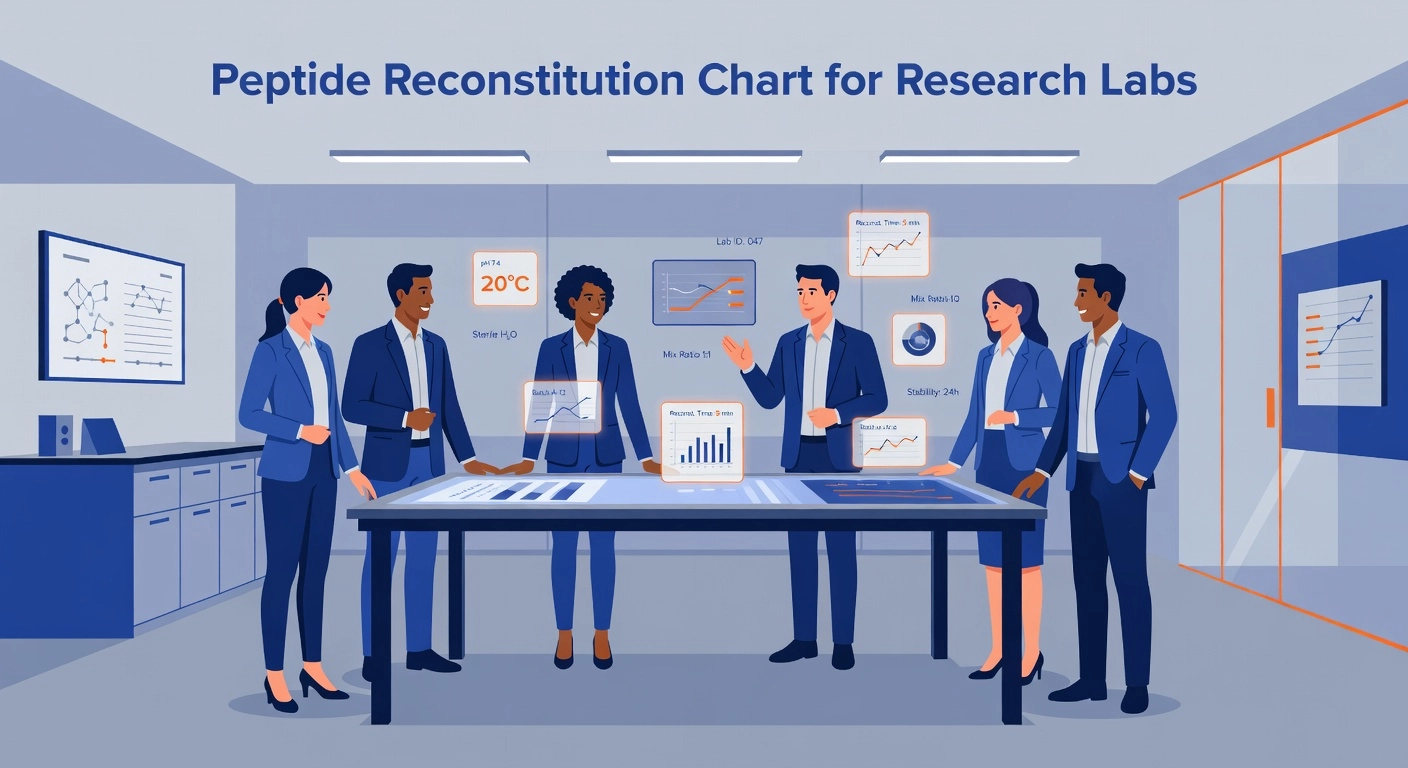
Peptide Reconstitution Chart for Research Labs
In the fast-paced world of research labs, accuracy in peptide handling is non-negotiable. A single miscalculation during reconstitution can compromise experimental results, waste valuable resources, or even invalidate months of work. Intermediate researchers know this all too well; the challenge lies in determining the precise volumes of bacteriostatic water or solvent needed for various peptide quantities and desired concentrations.
Enter the peptide reconstitution chart, your essential reference tool for streamlining this process. This comprehensive guide demystifies reconstitution calculations, providing clear, lab-tested formulas and visuals tailored for peptides like BPC-157, TB-500, and semaglutide. No more guesswork or endless online searches.
In this tutorial, you will learn how to read and apply the peptide reconstitution chart step by step. We cover concentration goals from 1mg/mL to 10mg/mL, account for vial sizes, and include pro tips for sterile techniques and storage. By the end, you will confidently prepare stock solutions that enhance reproducibility and efficiency in your protocols. Let’s dive in and elevate your lab precision.
Understanding Peptide Reconstitution in Lab Research
Peptide reconstitution is the essential laboratory process of dissolving lyophilized (freeze-dried) peptide powders in appropriate solvents, such as bacteriostatic water, to prepare stable solutions for experimental applications. This step demands precision, as inaccurate solvent volumes or aggressive mixing can cause degradation, aggregation, precipitation, or loss of peptide integrity, undermining analytical results in research settings. Researchers typically add solvent slowly along the vial wall, gently swirl to dissolve, and verify clarity before use, maintaining sterility throughout. For optimal stability, reconstituted solutions are stored at 2-8°C, with stability often lasting weeks under proper conditions. Accurate reconstitution ensures consistency in assays like cell proliferation or binding studies. Detailed protocols
Peptide reconstitution charts serve as invaluable visual aids, tabulating vial masses (e.g., 5 mg or 10 mg) against solvent volumes to achieve target concentrations (e.g., 2.5 mg/mL). For instance, adding 2 mL bacteriostatic water to a 5 mg vial yields 2.5 mg/mL, simplifying syringe-based dosing calculations. The surge in demand reflects over 20 online calculators and mobile apps available in 2026, highlighting the need for error-free precision in lab workflows. Reconstitution guide
In Research Use Only (RUO) contexts, suppliers like NorthWestPeptide provide high-purity peptides (≥99% via HPLC/MS), including BPC-157 and GLP-1 analogs, accompanied by Certificates of Analysis (COAs) for batch verification. Precise reconstitution upholds analytical validity in studies on metabolic regulation or tissue models. Common peptides vary by class: growth factors like TB-500 (highly water-soluble, 1-2 mL per vial); secretagogues such as CJC-1295 (stable in bacteriostatic water blends); and analogs like GHK-Cu (prefers neutral pH to avoid precipitation). Solubility differences guide solvent selection for reliable experimental outcomes. NorthWestPeptide resources
Key Factors Influencing Reconstitution
Peptide Quantity
Typical lyophilized peptide vials from suppliers like NorthWestPeptides range from 2 to 10 mg, directly dictating solvent requirements in peptide reconstitution charts. For instance, a 2 mg vial of research peptides like GHK-Cu suits low-volume experiments needing 0.5-1 mL solvent, while 5-10 mg vials for compounds such as TB-500 require 2-5 mL to achieve workable concentrations. This sizing prevents over-dilution, which risks hydrolysis and reduced stability during in vitro assays. Researchers select volumes based on syringe precision, such as 1 mL insulin syringes marked in 100 units for microgram accuracy.
Desired Concentration
Experimental objectives determine target concentrations of 1-5 mg/mL, balancing solubility and dosing precision. The core formula, Volume (mL) = Mass (mg) / Concentration (mg/mL), guides calculations; a 5 mg vial at 2 mg/mL needs exactly 2.5 mL solvent. Lower concentrations (1 mg/mL) aid cellular studies requiring small injections, whereas 5 mg/mL supports stability in longer protocols. Actionable insight: Use digital calculators to verify, ensuring reproducibility across batches.
Solvent Choice
Bacteriostatic water remains preferred for its 0.9% benzyl alcohol content, enabling 28-30 days stability at 2-8°C post-reconstitution. Sterile water serves short-term, single-use applications but lacks preservatives. Gently swirl at room temperature; avoid shaking to prevent aggregation.
Purity Standards
NorthWestPeptides’ GMP manufacturing yields >99% purity via HPLC/MS, minimizing impurities that impair solubility or cause precipitation. COAs confirm batch consistency, essential for reliable research outcomes. Cloudiness post-mixing indicates issues; discard and reverify documentation.
Step-by-Step Peptide Reconstitution Tutorial
Gather Your Materials
Begin by assembling all necessary items in a clean, aseptic laboratory workspace to ensure research-grade precision. Essential components include a sterile 1 mL insulin syringe with 100-unit markings for accurate measurement, bacteriostatic (BAC) water as the preferred solvent due to its 0.9% benzyl alcohol content for multi-dose stability, alcohol swabs for sterilization, and a lyophilized peptide vial such as NorthWestPeptides’ 5 mg BPC-157. Optional tools like gloves, a larger syringe (3-5 mL) for drawing solvent, and 18-22G needles for solvent extraction enhance safety and efficiency. NorthWestPeptides products meet strict purity standards with full analytical documentation, supporting reliable experimental outcomes. Always verify vial integrity and expiration before proceeding.
Calculate Volume Using a Peptide Reconstitution Chart or Formula
Determine the solvent volume with the formula: Concentration (mg/mL) = Peptide mass (mg) / Solvent volume (mL). Target 1-5 mg/mL for precise syringe dosing in research applications. For a 5 mg BPC-157 vial from NorthWestPeptides, consult a peptide reconstitution chart like this example:
| BAC Water (mL) | Concentration (mg/mL) | Dose per 0.1 mL (10 units) |
|---|---|---|
| 1.0 | 5.0 | 500 mcg |
| 2.0 | 2.5 | 250 mcg |
| 3.0 | 1.67 | 167 mcg |
| 5.0 | 1.0 | 100 mcg |
Draw BAC water slowly into the syringe to prevent air bubbles or foaming, which can degrade peptide integrity. Digital calculators from trusted research tools can automate this for peptides like BPC-157 or GLP-1 analogs.
Reconstitute the Peptide
Equilibrate the vial and solvent to room temperature for 15-20 minutes to avoid moisture issues. Wipe stoppers with alcohol swabs and let dry. Inject solvent at a slight angle along the vial wall, allowing it to flow gently over the powder. Slowly swirl or roll the vial for 15-30 minutes until fully dissolved; never shake to prevent shear stress or denaturation. The solution must appear clear and particle-free; discard if cloudy. For verification, use a spectrophotometer like those measuring the Amide I band at ~1650 cm⁻¹ for precise concentration confirmation in advanced labs.
Reconstituted solutions from NorthWestPeptides peptides remain stable at 2-8°C for up to 30 days, ideal for ongoing research. All processes are for laboratory research use only (RUO). Reconstitution best practices Storage guide BPC-157 example
Comprehensive Peptide Reconstitution Chart
5 mg Vials (e.g., Ipamorelin)
Research peptides in 5 mg lyophilized vials, such as those offered by NorthWestPeptide, require precise solvent volumes to achieve target concentrations. The peptide reconstitution chart below provides standard bacteriostatic water (BAC) volumes for common lab concentrations, ensuring accurate solution preparation under research-use-only (RUO) conditions.
| Desired Concentration | BAC Water (mL) |
|---|---|
| 1 mg/mL | 5 |
| 2 mg/mL | 2.5 |
| 5 mg/mL | 1 |
These ratios follow the universal formula: BAC volume (mL) = peptide mass (mg) / desired concentration (mg/mL). NorthWestPeptide peptides, verified by HPLC for >99% purity, maintain stability when reconstituted gently and stored at 2-8°C.
10 mg Vials (e.g., TB-500)
For larger 10 mg vials, scale the solvent proportionally to match experimental needs. This chart supports consistent concentrations in tissue repair analog studies.
| Desired Concentration | BAC Water (mL) |
|---|---|
| 1 mg/mL | 10 |
| 2 mg/mL | 5 |
| 5 mg/mL | 2 |
Always use sterile techniques to prevent contamination, aligning with NorthWestPeptide’s strict manufacturing standards.
GLP-1 Analogs (15 mg Vials)
NorthWestPeptide’s GLP-1 analog offerings in 15 mg vials demand adjusted volumes for research protocols. Example: 3 mL BAC yields 5 mg/mL.
| Desired Concentration | BAC Water (mL) |
|---|---|
| 5 mg/mL | 3 |
| 2.5 mg/mL | 6 |
| 1 mg/mL | 15 |
These facilitate analytical documentation in mechanism studies.
Customization and Scaling
Scale any chart proportionally using the formula above for non-standard vials. For instance, a 20 mg vial at 2 mg/mL requires 10 mL BAC. NorthWestPeptide provides a downloadable PDF peptide reconstitution chart for lab use via their Resources page, enabling quick reference and batch-specific adjustments. Digital calculators complement this for mcg/mL conversions.
Research Protocol Examples
BPC-157 (5 mg Vial): Common in 2026 protocols for gastric peptide classification.
| Concentration | BAC (mL) |
|---|---|
| 5 mg/mL | 1 |
| 2.5 mg/mL | 2 |
CJC-1295 (5 mg Vial): Used in growth hormone-releasing studies.
| Concentration | BAC (mL) |
|---|---|
| 2.5 mg/mL | 2 |
| 1 mg/mL | 5 |
Reconstituted solutions from NorthWestPeptide products remain stable for up to 30 days at 2-8°C, supporting rigorous lab research. For detailed guides, see peptide reconstitution overview. All for RUO; verify purity certificates.
Post-Reconstitution Storage and Stability
Once reconstitution is complete using guidelines from a peptide reconstitution chart, proper storage becomes critical to maintain peptide integrity for laboratory research. Reconstituted solutions are more susceptible to degradation from hydrolysis, oxidation, and microbial growth compared to lyophilized forms. Researchers should prioritize refrigeration at 2-8°C, where industry standards indicate stability for up to 30 days under sterile conditions. For instance, solutions prepared with bacteriostatic water in 5 mg vials, such as Ipamorelin, retain over 95% purity during this period when stored upright and protected from light. Always monitor for cloudiness or precipitation, discarding any compromised solutions to ensure experimental accuracy. Detailed guidelines are available from established sources like Peptide Sciences storage information and Bachem handling recommendations.
To preserve bioactivity, avoid repeated freeze-thaw cycles, which can cause aggregation and up to 50% loss in sensitive sequences. Instead, freeze aliquots at -20°C or -80°C immediately after reconstitution. This practice supports consistent results in analytical experiments, aligning with NorthWestPeptide’s emphasis on research-grade purity.
Aliquoting into single-use sterile vials (e.g., 100-500 µL portions) minimizes contamination risks from repeated needle access and reduces air exposure. Use low-protein binding tubes to prevent adsorption losses.
NorthWestPeptide’s FAQ reinforces these protocols, stressing third-party Certificates of Analysis (COAs) with HPLC/MS data to verify post-storage stability and ≥99% purity for every batch. Request batch-specific documentation to validate your research setup. See GenScript storage guidelines for additional best practices. These steps ensure reliable, reproducible outcomes in laboratory applications.
Best Practices and Troubleshooting
Sterility Protocols in Laboratory Environments
Maintaining sterility during peptide reconstitution is paramount for reliable research outcomes. Always perform the process under a laminar flow hood (LFH) to generate unidirectional sterile airflow, drastically reducing airborne contaminants. Wipe all surfaces with 70% ethanol, don nitrile gloves and a lab coat, and use only sterile syringes, needles, and filters. Disinfect vial septa thoroughly before solvent injection. This setup minimizes microbial risks, particularly for multi-dose vials used in extended studies. For detailed protocols, refer to best practices for reconstituting lyophilized peptides.
Addressing Precipitation Issues
Precipitation can arise from incompatible solvents, extreme pH, or high concentrations, compromising solution clarity. Gently warm the vial in a 37°C water bath for 10-15 minutes while swirling, avoiding temperatures above this to prevent denaturation. If research-appropriate, adjust pH using dilute acetic acid (5-10%) for basic peptides or ammonium bicarbonate for acidic ones, targeting neutrality near pH 7; verify with a calibrated pH meter. Dilute further or switch to alternatives like PBS with 5% DMSO for hydrophobic compounds. Filter through a 0.22 μm sterile filter if particulates persist. See reconstitution troubleshooting tips for solvent-specific guidance.
Batch Documentation and Reproducibility
Document every batch meticulously: record peptide lot number, solvent volume, reconstitution date, concentration, and visual observations. NorthWestPeptide supplies Certificates of Analysis (COAs) with each batch, confirming ≥99% purity via HPLC and mass spectrometry, essential for experimental reproducibility.
Embracing 2026 Digital Trends
Complement traditional peptide reconstitution charts with digital calculators like mobile apps, which compute volumes instantly, reduce errors by up to 50%, and integrate GLP-1 analog presets. These tools enable quick syringe draw references, saving lab time while enhancing precision in dynamic research workflows.
Key Takeaways for Precise Research
For precise laboratory research, download our peptide reconstitution chart PDF for quick access at the bench. This visual guide consolidates solvent volumes, such as bacteriostatic water additions for 5 mg vials targeting 1-5 mg/mL concentrations, streamlining workflows for peptides like Ipamorelin or GHK-Cu.
Always prioritize research use only (RUO) protocols, verifying supplier purity through HPLC/MS certificates, which confirm >98% purity standards essential for reproducible experiments. NorthWestPeptide upholds these rigorous analytics, ensuring batch-to-batch consistency.
Integrate the chart with storage best practices: reconstituted solutions remain stable at 2-8°C for up to 30 days, preventing degradation and supporting reliable data. Explore NorthWestPeptide resources, including batch search tools and expert support, for high-quality peptides tailored to your studies.
Actionable insight: Test reconstitution on a small scale first, using 10-20% of your vial to confirm solubility and clarity before full preparation, minimizing waste and errors in sensitive assays.
Conclusion
In summary, accurate peptide reconstitution is vital to avoid experimental errors and wasted resources. This guide delivers a comprehensive chart that simplifies calculations for peptides like BPC-157, TB-500, and semaglutide, covering concentrations from 1mg/mL to 10mg/mL. Key takeaways include step-by-step chart usage, sterile handling techniques, vial size considerations, and optimal storage practices. These tools eliminate guesswork and boost lab efficiency.
Download the free peptide reconstitution chart now, bookmark this post for quick reference, and share it with your research team. Equip your lab with precision today. Your groundbreaking discoveries depend on it; start reconstituting with confidence and drive your science forward.