 UNLIMITED Buy 1, Get 1 FREE ON GLP-1S • No Limit • While Supplies Last
  Free 2-Day Shipping on $150+ — Same Day Ship Before 2 PM PST*
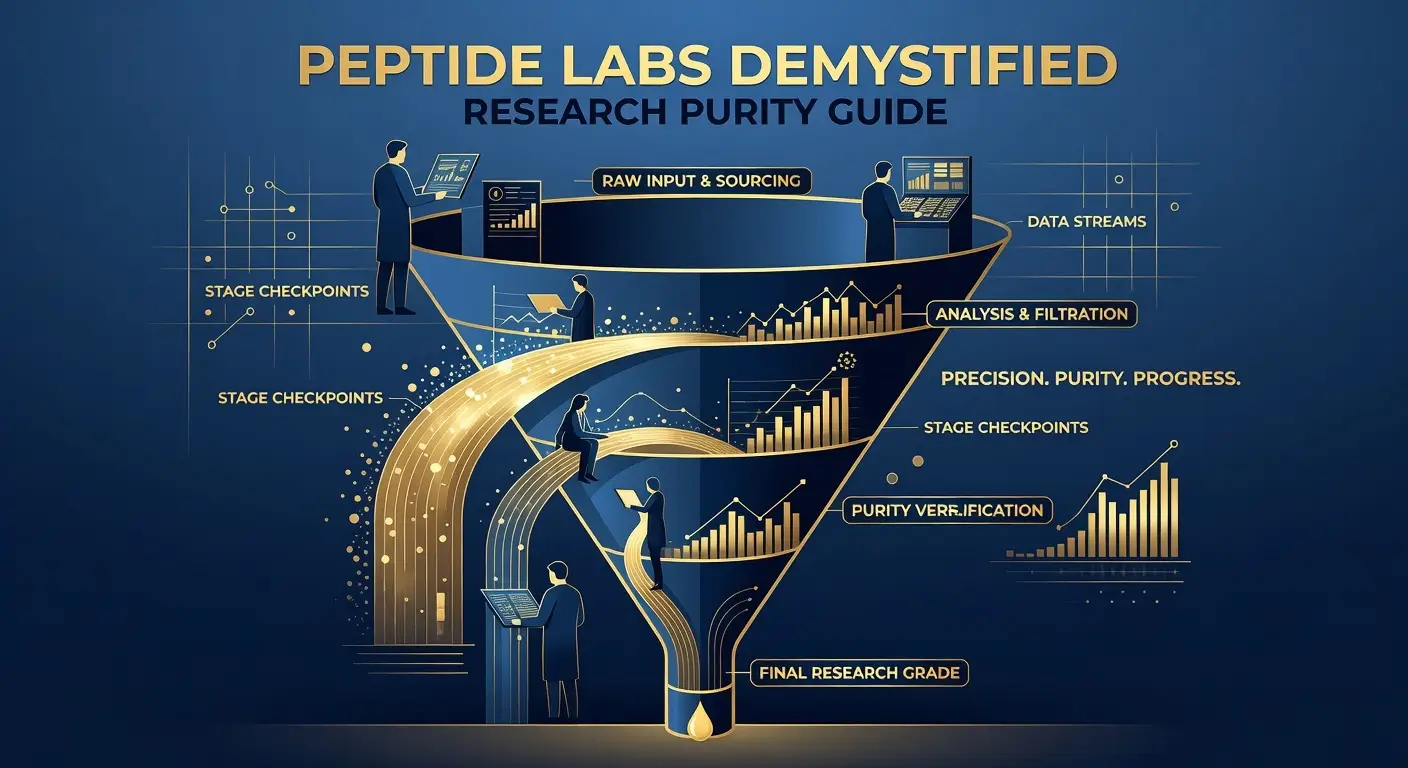
Peptide Labs Demystified: Research Purity Guide
In the fast-evolving field of peptide research, one question looms large for intermediate scientists and enthusiasts: how do you ensure the peptides fueling your experiments are truly pure? Impurities can derail results, waste resources, and undermine conclusions. Yet, sourcing from reputable peptide labs remains a puzzle shrouded in marketing claims and vague certificates.
This guide demystifies peptide labs, offering a clear analysis of research purity standards. We dissect key metrics like HPLC and MS purity levels, scrutinize third-party testing protocols, and highlight red flags in vendor practices. You will learn to evaluate Certificates of Analysis (CoA) beyond surface-level numbers, compare domestic versus international peptide labs, and apply practical benchmarks for selecting high-quality suppliers.
By the end, you will possess the tools to make informed decisions, safeguarding your research integrity. Whether optimizing protocols or scaling experiments, this analysis equips you to navigate peptide labs with confidence and precision. Dive in to transform uncertainty into expertise.
Defining Peptide Labs in Scientific Research
Peptide labs serve as specialized facilities dedicated to the synthesis of high-purity research peptides, typically short chains of 2 to 100 amino acids linked by peptide bonds, supplied in lyophilized form for optimal stability in laboratory settings. These labs focus exclusively on producing compounds for research use only (RUO), emphasizing purity levels of ≥99% verified through high-performance liquid chromatography (HPLC) and mass spectrometry (MS), along with comprehensive Certificates of Analysis (COAs) for batch traceability and reproducibility. Researchers rely on these labs to obtain consistent, high-quality peptides that enable precise analysis of biological interactions, protein structures, and signaling pathways without the need for in-house synthesis. For instance, NorthWestPeptide exemplifies this role by manufacturing peptides under strict quality controls, including third-party testing and endotoxin-free standards, supporting applications in biochemistry, drug discovery, and biotech R&D. The global peptide synthesis market, projected to reach USD 6.3 billion by 2035 with a CAGR of 7.81%, underscores the growing demand for such reliable sources amid advances in automated production.
Common peptide types produced in these labs include linear peptides, which consist of straight amino acid chains ideal for foundational sequence studies and receptor binding assays; cyclic peptides, featuring ring structures like disulfide-bridged forms that enhance stability, enzyme resistance, and cellular uptake; and modified peptides incorporating non-natural amino acids or labels for specialized properties. These classifications support diverse research models, such as neurological studies probing neurotransmitter pathways, metabolic investigations into glucose regulation mechanisms, and cosmetic research examining skin penetration dynamics. For more on research peptides, see this comprehensive guide.
The cornerstone synthesis method in peptide labs is solid-phase peptide synthesis (SPPS), particularly the Fmoc/tBu strategy, which anchors the C-terminal amino acid to a resin bead, followed by iterative cycles of deprotection, coupling with protected amino acids using activators like HBTU, washing, and final cleavage with trifluoroacetic acid (TFA). This automated process ensures batch consistency by standardizing conditions, monitoring reaction completion via chromophores or conductivity, and purifying via reverse-phase HPLC, yielding crude purities often exceeding 90%. Microwave-assisted or flow SPPS variants further improve yields for longer sequences, reducing aggregation risks. Detailed SPPS mechanics are outlined here.
Peptide labs extend their utility through custom modifications like PEGylation, which attaches polyethylene glycol chains to improve solubility and half-life in experimental models, or C-terminal amidation, enhancing protease resistance for stability studies. These alterations, integrated during SPPS, enable tailored applications across neurology, metabolism, and cosmetics, with over 300 options available for precise research needs. Such capabilities, backed by expert support, empower investigators to explore undruggable targets effectively.
Core Quality Standards in Peptide Labs
In peptide labs, achieving core quality standards is paramount for ensuring the reliability of research-grade compounds in laboratory settings. As the global peptide synthesis market, valued at USD 6.3 billion with a projected CAGR of 7.81% through 2035, continues to expand, researchers demand peptides that meet stringent benchmarks to support reproducible outcomes. Leading suppliers like NorthWestPeptide uphold these standards through rigorous testing and documentation, focusing exclusively on research use only (RUO) applications. This section examines key elements: purity verification, analytical certificates, stability formats, and manufacturing traceability.
Purity Benchmarks: ≥99% Verified by Third-Party HPLC and Mass Spectrometry (MS)
Purity levels of ≥99% represent the gold standard in peptide labs, minimizing impurities such as truncation products or oxidation variants that could alter experimental results. Reversed-phase high-performance liquid chromatography (RP-HPLC) employs a C18 column with UV detection at 214-220 nm to quantify purity as the ratio of the main peak area to total peak area, often achieving 99.7% or higher in verified batches. Mass spectrometry (MS), including electrospray ionization (ESI-MS), complements this by confirming molecular weight within ±1 Da of theoretical values, detecting issues like deletions invisible to HPLC. Third-party ISO 17025-accredited labs conduct these tests, as internal validations alone may overlook discrepancies; studies indicate up to 25% of peptides fail independent checks. For instance, NorthWestPeptide’s products undergo such dual verification, ensuring accurate identity for downstream assays. This benchmark is critical amid 2026 trends emphasizing AI-assisted purity analysis for complex sequences. Peptide Therapeutics Market Analysis
Certificates of Analysis (COAs): Batch-Specific Documentation
COAs provide indispensable, lot-specific proof of quality, detailing HPLC purity, endotoxin levels (<0.25 EU/mg to prevent assay interference), and residual solvents like TFA or acetonitrile via GC-MS. Additional metrics include moisture content, counter-ion profiles, and amino acid analysis, aligning with USP <1225> validation guidelines for RUO contexts. Researchers should insist on batch-traceable COAs over generic templates, as these enable precise replication across studies. NorthWestPeptide supplies these upon request, documenting every production run for transparency. In an era of heightened regulatory scrutiny, such records safeguard against variability, with experts noting their role in FDA-compliant research workflows.
Lyophilized Powder Formats for Long-Term Stability
Lyophilized (freeze-dried) powders are the preferred format in peptide labs, eliminating water to protect against hydrolysis, oxidation, and degradation. Stored at -20°C in dark, dry conditions, they maintain integrity for up to 24 months; at 2-8°C, stability extends 12-24 months, per stability studies in COAs. Reconstitution yields solutions viable for 4-6 weeks refrigerated, with animal-component-free processes further enhancing shelf life. This format supports NorthWestPeptide’s commitment to consistent research materials, reducing experimental artifacts from instability.
ISO-Compliant Manufacturing and Traceability
ISO 9001:2015-compliant processes in peptide labs ensure end-to-end traceability from raw, animal-origin-free materials through solid-phase synthesis, purification, and capping. Validated steps include sterile handling and endotoxin control, with batch records linking to analytical data from accredited labs. This framework guarantees reproducibility, bridging RUO purity with research demands without GMP clinical validations. Suppliers like NorthWestPeptide exemplify this, empowering precise investigations in fields like drug discovery. Peptide Synthesis Market Report As market growth accelerates, these standards remain foundational for trustworthy peptide research. FDA Peptide Reclassification Insights
Market Trends Driving Peptide Lab Innovations
Global Peptide Synthesis Market Expansion
The global peptide synthesis market, projected to reach USD 6.3 billion in 2026, exemplifies the surging demand for research-grade compounds essential to laboratory investigations. This valuation, drawn from detailed market analyses, anticipates a compound annual growth rate (CAGR) of 7.81% through 2035, driven by advancements in solid-phase peptide synthesis and high-throughput automation. Peptide labs are responding by scaling production of high-purity (≥99%) lyophilized peptides, supported by third-party HPLC/MS testing for batch consistency. Researchers benefit from this growth through access to stable formulations suitable for protein interaction studies and epitope mapping. For precise projections, refer to the Research Nester peptide synthesis market report. Such trends underscore the need for labs to prioritize analytical documentation, including certificates of analysis (COAs), to meet rigorous research standards.
Influence of Peptide Therapeutics Market Growth
Parallel to synthesis advancements, the peptide therapeutics market’s expansion to USD 146.34 billion by 2034, at a 10.91% CAGR, profoundly influences lab-scale analog development. This growth stems from preclinical demands for modified peptides, such as those with extended half-lives via PEGylation or cyclic structures, tested in controlled laboratory environments. Peptide labs facilitate this by offering custom synthesis services, enabling researchers to explore structure-activity relationships without therapeutic implications. Data from industry reports highlight North America’s dominance, where U.S.-based facilities invest in computational modeling for novel sequences. These dynamics compel labs to maintain research-use-only (RUO) designations, ensuring compounds remain strictly for analytical purposes. Actionable insight for researchers: request detailed purity profiles before procurement to validate analog reproducibility in experiments.
Regulatory Shifts Emphasizing RUO Peptides
FDA Category 2 restrictions, implemented since 2023 on select peptides, have redirected focus toward RUO products in peptide labs. These regulations prohibit compounding for non-research applications, prompting suppliers to enforce strict disclaimers against human or animal consumption. Labs now emphasize compliance through lot-specific COAs, chain-of-custody tracking, and purity verification exceeding 99%. This shift mitigates risks associated with impurities or immunogenicity in research settings. For instance, peptides like those under review require enhanced documentation to support legitimate scientific inquiry. Researchers should verify vendor adherence to these standards, prioritizing those with transparent testing protocols.
USA-Based Lab Innovations in Shipping and Synthesis
USA-based peptide labs lead with temperature-controlled shipping to preserve lyophilized peptide integrity during transit, critical for compounds sensitive to ambient conditions. Custom synthesis capabilities, from milligram to kilogram scales, cater to advanced studies in neurological and metabolic research analogs. Facilities employ automated synthesizers and green chemistry to deliver consistent, high-purity outputs backed by expert support. Free shipping thresholds and same-day processing further streamline access for investigators. See insights on manufacturing trends in the Precedence Research peptide synthesis analysis. These innovations position labs like NorthWestPeptide to empower precise, reproducible laboratory work amid evolving market demands.
Storage and Handling Best Practices in Peptide Labs
In peptide labs, meticulous storage and handling protocols are essential to preserve the structural integrity and analytical purity of lyophilized research peptides, ensuring reliable experimental outcomes. Lyophilized forms, common in high-purity (≥99%) products from reputable suppliers, maintain stability through minimized moisture and oxygen exposure. Degradation mechanisms such as hydrolysis, oxidation, and aggregation can compromise sequences with sensitive residues like methionine, cysteine, or asparagine, leading to up to 20-30% activity loss from improper handling.
Lyophilized Peptide Storage at -20°C
Research-grade lyophilized peptides should be stored at -20°C in a non-frost-free freezer to retain over 95% integrity for 1-2 years, as supported by industry guidelines. For long-term archiving exceeding one year or oxidation-prone compounds, -80°C is optimal. Aliquoting into single-use vials prior to storage prevents freeze-thaw cycles, which accelerate degradation 2-5 times faster than consistent low temperatures and cause microcondensation-induced aggregation. Allow vials to warm to room temperature in a desiccator for 20 minutes before opening to avoid hygroscopic moisture uptake. Suppliers like NorthWestPeptide, with third-party HPLC/MS-tested batches, emphasize these practices alongside COAs for verification. Short-term room temperature storage is viable for days but risks rapid purity decline. For detailed protocols, consult the Sigma-Aldrich Peptide Handling Guide.
Reconstitution Under Sterile Conditions
Reconstitute peptides in a laminar flow hood using bacteriostatic water (0.9% benzyl alcohol) for analytical preparations, employing aseptic techniques with gloves, sterilized syringes, and alcohol wipes. Add solvent dropwise, gently vortex or sonicate below 40°C for 15-30 minutes, and verify solubility via HPLC. Select solvents by peptide charge: acidic sequences in dilute ammonia, basic in 25% acetic acid, hydrophobic in DMSO-water mixes. Aliquot immediately and store solutions at -20°C in pH 5-6 buffers for weeks-long stability. See GenScript storage guidelines for sequence-specific advice.
Documentation and Shipping Best Practices
Log all conditions—temperature, aliquot dates, solvents—in electronic lab notebooks to support GLP compliance and reduce experimental variability by 15-20%. For shipping, employ cold chain logistics with insulated packaging, gel packs, and data loggers to maintain -20°C, ensuring 99% bioactivity retention upon receipt, even for expedited delivery. Lyophilized peptides tolerate room temperature transit briefly, but solutions demand dry ice. These steps align with RUO standards, empowering precise research.
Criteria for Selecting Reliable Peptide Labs
Selecting reliable peptide labs requires a systematic evaluation to ensure research integrity, batch reproducibility, and adherence to Research Use Only (RUO) standards. Researchers must scrutinize suppliers through verifiable metrics, prioritizing transparency in quality assurance amid a global peptide synthesis market projected to reach USD 6.3 billion by 2026, growing at a 7.81% CAGR. Key criteria include analytical documentation, operational logistics, catalog diversity, and support infrastructure, all of which safeguard experimental outcomes.
Third-Party Testing Transparency and Accessible COAs for Every Batch
Demand batch-specific Certificates of Analysis (COAs) from ISO 17025-accredited independent labs, featuring HPLC chromatograms confirming ≥99% purity, mass spectrometry for molecular identity, and tests for endotoxins, heavy metals, and microbial contaminants. Actionable verification involves matching COA lot numbers to vials, reviewing dated spectra (ideally within 90 days), and requesting raw data files. Vendors providing public or on-request COA archives minimize risks of impurities that could skew results, as independent testing typically costs USD 400-1,200 per sample. For instance, chromatograms revealing distinct peaks without shoulders indicate high-resolution synthesis via solid-phase peptide synthesis (SPPS). This transparency aligns with FDA RUO compliance, reducing experimental failures. Resources like vendor evaluation guides outline red flags such as generic templates or in-house-only reports.
US-Based Operations for Compliant Domestic Shipping
Opt for operations in the United States, such as those in Spokane, WA, to leverage faster 1-2 day shipping with temperature-controlled packaging (−20°C lyophilized stability up to 24 months). Domestic facilities avoid international customs delays and ensure cold-chain integrity via dry ice or gel packs, critical for compound stability. Spokane’s research ecosystem, including university-affiliated services, supports compliant RUO distribution with same-day processing. Free shipping thresholds over USD 100 further enhance efficiency for bulk orders.
Product Range Including Bundles and Custom Options
Examine catalogs for comprehensive offerings: standard lyophilized peptides, research bundles (e.g., synergistic stacks for neurological studies), and custom synthesis like PEGylated or labeled variants tailored to specific sequences. This flexibility accommodates diverse applications in oncology or cognitive research, with automated SPPS enabling rapid prototyping.
Expert Support for Selection and Documentation
Choose labs with PhD-level chemists providing guidance on solubility, salt forms (acetate vs. TFA), and batch requests, without venturing into non-RUO topics. Responsive teams with quality assurance protocols, including CAPA systems, foster trust through technical consultations. Prioritizing these elements ensures peptide labs deliver consistent, high-purity compounds for robust scientific inquiry.
Actionable Takeaways for Peptide Research
Verify Purity with Independent Testing
Researchers procuring from peptide labs must prioritize verifying supplier purity claims through independent HPLC/MS reports prior to any purchase. These analytical techniques provide quantitative data on peptide composition, identifying impurities below 1% that could skew experimental results. For instance, high-performance liquid chromatography (HPLC) separates peptide variants by hydrophobicity, while mass spectrometry (MS) confirms molecular weight accuracy, ensuring ≥99% purity standards common in research-grade materials. NorthWest Peptides exemplifies this by offering third-party tested reports, enabling researchers to confirm batch consistency without relying solely on vendor assurances. This step mitigates risks in downstream applications like binding assays or structural studies.
Optimize Storage and Stability Tracking
Maintaining peptides at -20°C in lyophilized form is critical, as it preserves structural integrity for up to 24 months, preventing degradation from hydrolysis or oxidation. Labs should implement real-time stability tracking using periodic HPLC analysis to monitor purity loss over time, upholding experimental validity. Data from industry benchmarks show that improper storage can reduce purity by 5-10% within months, compromising reproducibility. Automated logging systems or freezer alarm protocols further safeguard against temperature excursions during handling.
Explore Emerging Classes Amid Market Growth
The global peptide synthesis market, projected at USD 6.3 billion by 2026 with a 7.81% CAGR, signals opportunities in emerging classes like GLP-1 analogs and nootropic peptides for innovative studies. Researchers can leverage these insights to investigate novel modifications, such as PEGylation for enhanced solubility. This growth, driven by advances in automated synthesis, encourages exploration beyond traditional categories into neurological and cosmetic research areas.
Secure COAs and Regulatory Compliance
Requesting Certificates of Analysis (COAs) from suppliers like NorthWest Peptides ensures access to consistent, high-quality RUO materials, detailing synthesis methods and purity metrics. Staying abreast of regulatory updates, including FDA Category 2 restrictions on certain compounds since 2023, reinforces that all peptides remain strictly for laboratory use. Subscribing to industry newsletters or monitoring official guidelines prevents non-compliance risks in procurement pipelines.
Conclusion
In this guide, we have unpacked essential purity metrics like HPLC and MS levels, taught you to scrutinize Certificates of Analysis beyond basic numbers, exposed red flags in vendor practices, and outlined benchmarks for comparing domestic and international peptide labs. These insights empower you to select suppliers that deliver reliable, high-purity peptides for your experiments.
Armed with these tools, you can protect your research from impurities, save resources, and ensure robust results. The value is clear: informed choices elevate your work from tentative trials to breakthrough discoveries.
Apply these strategies today; audit your current suppliers or source your next batch with confidence. Your research integrity starts here, paving the way for scientific excellence.