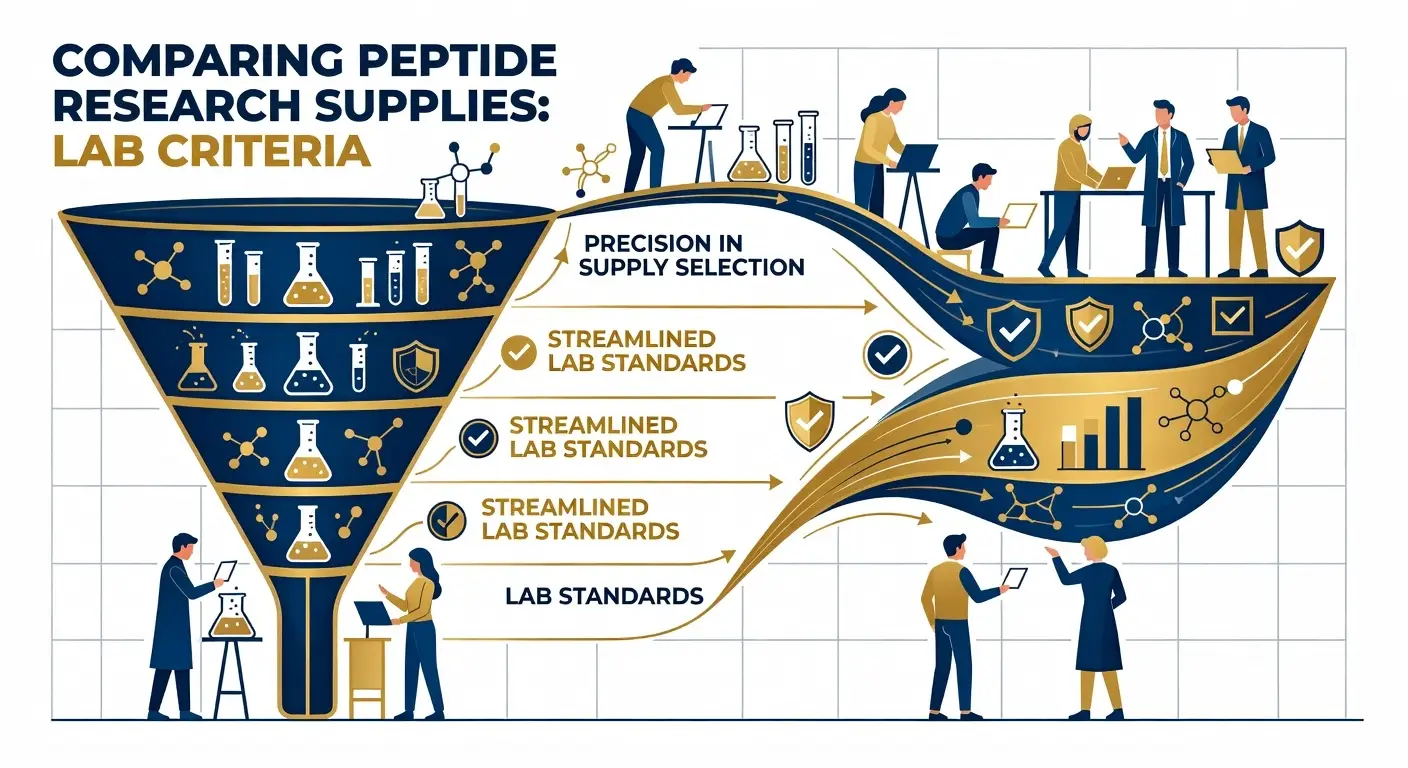
Comparing Peptide Research Supplies: Lab Criteria
In the competitive landscape of peptide research, where precision dictates breakthroughs, selecting the right peptide research supply can determine the success of your experiments. Subpar materials lead to inconsistent results, wasted resources, and delayed publications. Yet, with a proliferation of suppliers offering varied products, intermediate researchers often face challenges in discerning quality from mere affordability.
This comparison guide evaluates top peptide research supplies through essential lab criteria, including purity grades verified by HPLC and mass spectrometry, stability under storage conditions, scalability for custom syntheses, and compliance with regulatory standards like GMP. You will learn how leading providers stack up in head-to-head analyses, uncovering strengths such as rapid turnaround times from one vendor versus superior batch reproducibility from another. We also highlight cost-benefit ratios and real-world performance metrics drawn from lab feedback.
By the end, you will gain actionable insights to optimize your procurement decisions, streamline workflows, and elevate your research efficiency. Whether upgrading your current setup or building a new lab, this breakdown equips you with the knowledge to choose peptide research supplies that align with your project’s demands.
The 2026 Peptide Research Supply Landscape
The global peptide synthesis market is poised to reach $1.9 billion in 2026, expanding to $2.59 billion by 2031 at a 6.4% CAGR, propelled by surging research demand linked to therapeutics advancements. This growth reflects heightened needs in drug discovery, where high-purity research peptides enable precise mechanistic studies and analog development. For instance, innovations in peptide-drug conjugates and GLP-1 analogs have driven contract manufacturing expansions, underscoring the demand for reliable peptide research supply chains. Labs benefit from suppliers offering batch-specific Certificates of Analysis (COAs) via HPLC and mass spectrometry to verify ≥99% purity, ensuring reproducibility in experiments. Peptide synthesis market report.
In the U.S., the peptide therapeutics market will surge from $65.1 billion in 2024 to $160.3 billion by 2030, intensifying lab requirements for research-grade peptides in preclinical optimization. This boom contrasts with global trends, where Asia-Pacific CDMO investments lag in RUO compliance compared to North American standards. U.S. peptide therapeutics outlook.
Key 2026 trends include AI-driven peptide design, slashing R&D timelines by 30-40% through predictive modeling of non-natural amino acids, versus traditional solid-phase synthesis. Regulatory emphasis on RUO compliance counters DIY wellness misuse, favoring legitimate suppliers with third-party testing over unregulated sources. U.S.-based vendors excel here, providing 1-business-day temperature-controlled shipping (2-8°C) to preserve lyophilized peptide integrity, reducing degradation risks versus international delays. Researchers should prioritize these for consistent quality in storage-sensitive applications. 2026 research peptide vendor report.
Purity Standards in Peptide Research Supplies
Achieving ≥99% purity in peptide research supplies is essential for reliable laboratory experiments, where even trace impurities can compromise results. High-performance liquid chromatography (HPLC) and mass spectrometry (MS) serve as complementary gold-standard verification methods. HPLC excels in quantifying purity by separating peptides based on hydrophobicity, calculating the main peak area against total UV-detectable impurities (e.g., truncations or oxidations) at ≤1%, while MS confirms molecular identity and detects non-UV impurities like salts. Side-by-side, HPLC provides separation efficiency (pros: high resolution, routine use; cons: misses non-chromophoric contaminants), whereas MS offers precise mass accuracy (pros: sequence verification; cons: requires expertise). Together, they ensure accuracy in mechanism studies, as recommended for research-grade peptides here.
Suppliers like NorthWestPeptide deliver these in lyophilized powder form, enhancing long-term stability up to 24 months when stored at -20°C or below in sealed vials, protected from light and moisture. This format minimizes hydrolysis risks compared to liquid solutions, which degrade faster.
Batch-specific testing protocols include third-party HPLC-MS analysis, with Certificates of Analysis (CoAs) providing chromatograms, spectra, and lot data for traceability. NorthWestPeptide upholds these standards, offering verifiable documentation per batch.
Impurities skew peptide-receptor interaction studies by altering binding affinity or inducing off-target effects, underscoring the need for rigorous purity in research use only (RUO) applications detailed guide. Researchers should prioritize suppliers with transparent, high-purity protocols for reproducible outcomes.
Quality Documentation and COAs for Research
Certificates of Analysis (COAs) are essential batch-specific documents in peptide research supplies, verifying identity, purity, and quality through detailed analytical data. Reputable suppliers provide unique COAs per batch, accessible via lot lookup or download, featuring High-Performance Liquid Chromatography (HPLC) chromatograms that display purity levels (typically ≥99%) as the main peak percentage amid impurities, and Mass Spectrometry (MS) spectra confirming molecular mass within 1-2 Da of theoretical values. These visuals outperform simple numerical summaries by revealing impurity profiles critical for experimental accuracy. For instance, learn how to interpret peptide COAs to spot valid data.
Third-party testing by accredited labs elevates reliability over in-house analysis, offering unbiased validation of sequence accuracy and purity via standardized HPLC/MS protocols. Pros include transparency and reproducibility; cons of in-house testing involve potential bias, making third-party reports preferable for sensitive studies. Comprehensive COAs support Research Use Only (RUO) compliance by ensuring traceability, enabling precise dosing and minimizing assay interference from impurities under 5%.
| Feature | Basic COA | Comprehensive COA |
|---|---|---|
| Endotoxin (LAL) | Often omitted | <0.05 EU/mg |
| Residual Solvents | Minimal | Water 5-12%, TFA counterions via GC |
| Use Case | Routine screening | Cell culture, reproducibility-focused research |
This documentation fosters consistent laboratory outcomes. Explore COA essentials.
Shipping and Storage Best Practices
Temperature-controlled shipping is crucial for peptide research supplies to minimize degradation risks such as hydrolysis and oxidation during transit. Suppliers like NorthWestPeptide process orders within 1 business day from U.S. facilities, utilizing insulated packaging with desiccants and phase-change materials for 1-2 day delivery. This approach maintains lyophilized powders stable even under brief temperature fluctuations, outperforming ambient shipping which risks 10-20% purity loss in sensitive sequences.
Optimal Storage Protocols
Store lyophilized peptides at -20°C in sealed, light-protected vials for up to 24 months of stability, far superior to room temperature options that accelerate deamidation. For reconstitution, use bacteriostatic water (0.9% benzyl alcohol); gently swirl along vial walls, avoiding vigorous mixing to prevent aggregation. Aliquot into single-use portions post-reconstitution and refrigerate at 2-8°C for short-term use, limiting freeze-thaw cycles.
Bulk Order Strategies
Bulk purchases benefit from tiered pricing, offering 20-50% discounts, alongside enhanced insulated packaging for international labs facing 7-14 day transits. These ensure consistent supply for large-scale studies.
Proper handling preserves bioactivity essential for mechanism investigations and compound classifications, supporting reproducible results in receptor binding assays.
Custom Synthesis Options for Specialized Research
Custom peptide synthesis in peptide research supply enables precise tailoring for specialized laboratory experiments, incorporating modifications like PEGylation to improve solubility and half-life in stability assays, cyclization via disulfide or lactam bonds to mimic native structures in binding studies, and fluorescent labeling (e.g., FITC or TAMRA) for real-time imaging in cellular or protein interaction research. These enhancements support investigations into compound classifications such as receptor agonists or enzyme substrates, with storage typically as lyophilized powders stable up to 24 months at -20°C.
Researchers compare options by scale (mg for proof-of-concept to grams for scale-up), turnaround (5-21 business days standard), and costs (~$1-3 per amino acid, higher for modifications). NorthWestPeptide offers flexible mg-gram synthesis with competitive quotes, 1-business-day processing, and temperature-controlled delivery. All orders emphasize research use only (RUO), providing comprehensive analytical documentation: batch-specific COAs, HPLC/MS verifying ≥99% purity, and solubility data.
Supported categories span GLP-1 variants for signaling models, growth peptides for proliferation assays, and neurological compounds for synaptic research, aligning with the global synthesis market’s $1.9 billion 2026 valuation. Request quotes via their portal for expert support. ([170 words])
Side-by-Side Comparison of U.S. Suppliers
NorthWest Peptides
NorthWest Peptides stands out in the peptide research supply landscape with peptides achieving ≥99% purity, verified through third-party HPLC and mass spectrometry testing, accompanied by batch-specific Certificates of Analysis (COAs) accessible on product pages or via request. Their U.S.-based facilities enable 1-business-day processing and shipping via temperature-controlled priority carriers, with free shipping on orders over $100, ensuring minimal degradation risks for time-sensitive laboratory experiments. Custom synthesis options allow researchers to specify modifications such as PEGylation or cyclization, alongside categories covering GLP-1 variants and BPC-157 blends tailored for repair and recovery studies. Lyophilized products offer up to 24 months of stability under proper storage, supported by expert guidance on reconstitution and handling. This combination positions NorthWest Peptides as ideal for labs prioritizing speed, documentation, and compliance with strict research use only (RUO) standards.
Phoenix Pharmaceuticals
In contrast, Phoenix Pharmaceuticals brings over 30 years of experience in custom peptide synthesis, leveraging in-house quality control for high-purity research-grade compounds suitable for academic and pharmaceutical development. While their expertise excels in biologically active peptides and hormones, including potential GLP-1 and BPC-157 analogs, processing times extend to days or weeks due to rigorous customization protocols. Shipping lacks the rapid turnaround of NorthWest, focusing instead on precision for complex orders. COAs and QC reports are available, upholding RUO for laboratory applications exclusively. Researchers value their institutional trust, though urgency-driven projects may require alternatives.
Core Peptides and Peptide Research Supply
Core Peptides offers USA-made blends and bulk options at >98% purity with third-party testing, earning community trust for affordability in categories like BPC-157/TB-500 and GLP-1-related peptides, though reviews note occasional fulfillment variability. Free U.S. shipping over $200 supports bulk lab needs. Peptide Research Supply emphasizes niche high-quality testing with competitive purity and COAs on request, but trails in shipping speed and public documentation access, which is often login-gated; support is researcher-focused yet pricing remains somewhat opaque without account creation. Pros include specialized verification; cons involve slower accessibility compared to NorthWest’s efficiency.
| Factor | NorthWest Peptides | Phoenix Pharmaceuticals | Core Peptides | Peptide Research Supply |
|---|---|---|---|---|
| Purity Verification | ≥99% (3rd-party HPLC/MS, COAs) | High (in-house QC) | >98% (3rd-party HPLC) | High (COAs on request) |
| Shipping Speed | 1 business day (free >$100) | Slower (days/weeks) | Fast (free >$200) | Standard |
| Documentation Access | Batch COAs online/request | QC reports available | Per reviews | Contact/FAQ-gated |
| RUO Compliance | Strict lab-only | Lab/pharma development | Experimental use | Research chemicals |
This comparison highlights trade-offs in peptide research supply, aiding informed selection for laboratory needs. Peptide buzz climbs with influencer hype.
Trends Influencing Peptide Research Supplies
Artificial intelligence advancements are revolutionizing peptide discovery by enabling de novo design of novel structures, including cyclic peptides and those with unnatural amino acids, through deep learning models like GANs and diffusion models. These tools predict folding, solubility, and binding affinity, slashing development timelines from months to days and spiking demand for synthesis reagents and research-grade supplies. According to recent analyses, this drives a 7.81% CAGR in the global peptide synthesis market, valued at $1.9 billion in 2026 and projected to reach $2.59 billion by 2031 BioLongevity Labs 2026 report.
A notable shift involves research-use-only (RUO) peptides serving as analogs in skincare R&D for collagen analogs and functional foods studies targeting antioxidant sequences, all strictly for laboratory exploration. Concurrent regulatory scrutiny from the FDA on unregulated applications highlights the critical role of verified suppliers providing HPLC/MS-verified ≥99% purity and batch-specific COAs.
Supply chains are evolving toward traceable, high-purity U.S. sources, with North America commanding 37-40% market share, prioritizing cold-chain logistics and third-party testing for reproducible lab outcomes Precedence Research. Researchers should seek suppliers with these standards to navigate trends effectively AI peptide design overview.
Actionable Takeaways for Lab Researchers
For lab researchers navigating peptide research supplies, prioritize suppliers offering ≥99% purity verified by HPLC and mass spectrometry, accompanied by batch-specific Certificates of Analysis (COAs). These documents provide critical data on identity, purity, and residuals, ensuring experimental reproducibility and data integrity. For instance, selecting options with third-party testing minimizes variability in studies involving GLP-1 variants or growth peptides.
Opt for U.S.-based providers like NorthWest Peptides, which deliver 1-business-day processing with temperature-controlled shipping to preserve lyophilized stability up to 24 months. Their custom synthesis capabilities, including PEGylation or cyclization, support specialized protocols, while free shipping over $100 and bulk pricing enhance efficiency.
Always confirm strict Research Use Only (RUO) labeling and full analytical documentation prior to purchase to maintain institutional compliance. Leverage reconstitution FAQs for precise handling guidelines and submit quote requests for tailored needs. Finally, utilize shop filters and batch search tools to quickly identify peptides by category, such as neurological or anti-aging analogs, streamlining your workflow.
Conclusion
In summary, selecting peptide research supplies demands prioritizing purity verified by HPLC and mass spectrometry, ensuring stability and scalability for custom needs, and confirming regulatory compliance like GMP. Leading providers excel differently: one in rapid turnaround, another in batch reproducibility, with cost-benefit ratios revealing true value through lab feedback. This guide cuts through supplier noise to highlight reliable choices that prevent inconsistent results and wasted resources.
By applying these lab criteria, you safeguard experiment success and accelerate breakthroughs. Take action today: review your current supplier against our head-to-head analysis, request quotes from top performers, and optimize your workflow. Empower your research with precision; the next publication awaits your informed decision.