Research Papers on Protein: Lab Analysis Guide
Proteins form the backbone of biological processes, from enzymatic reactions to structural integrity in cells. Yet, unlocking their secrets often hinges on mastering the lab analyses detailed in scientific literature. If you are an intermediate researcher or student navigating the complexities of biochemistry, a well-crafted research paper on protein offers invaluable insights into experimental design, data interpretation, and validation techniques.
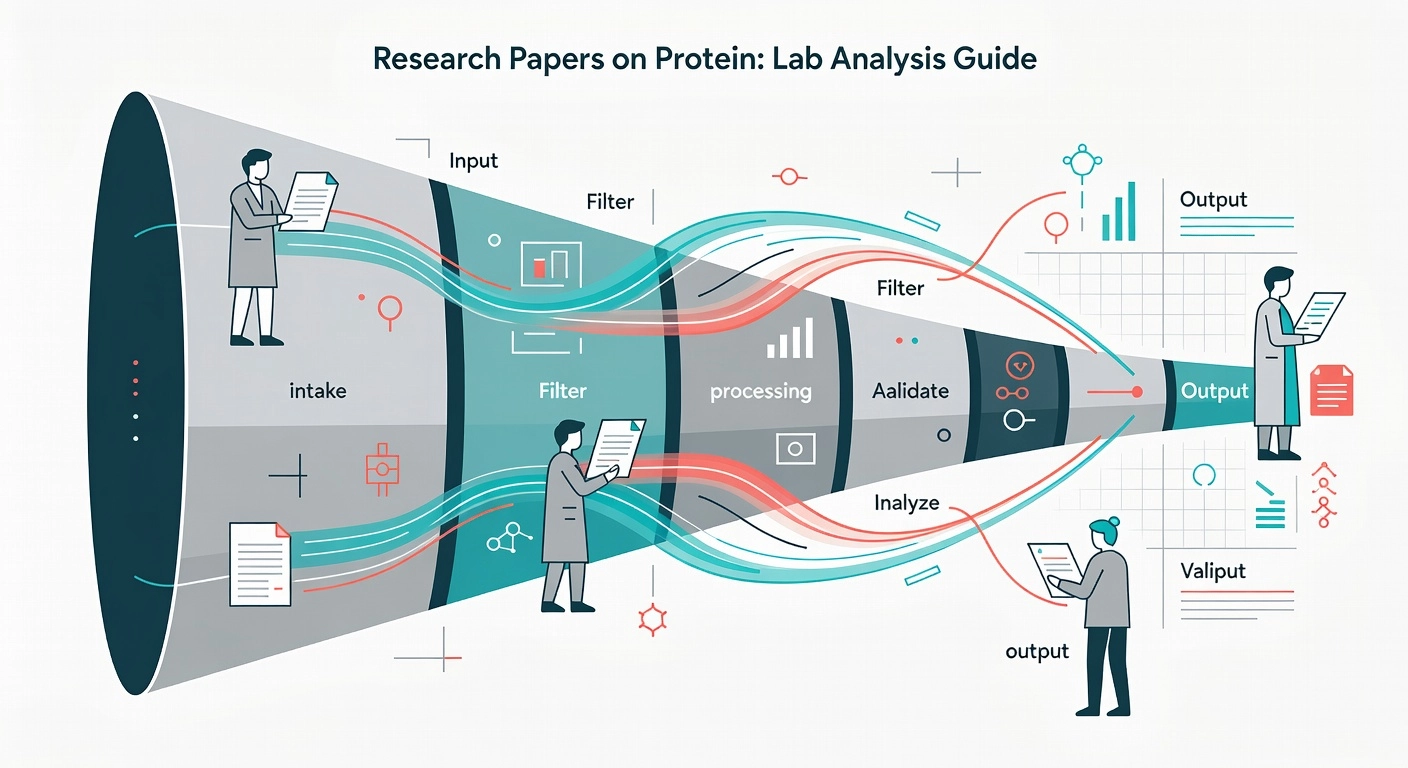
This guide demystifies the process of analyzing such papers. You will learn to dissect key sections like methodology, where techniques such as SDS-PAGE, mass spectrometry, and fluorescence spectroscopy are scrutinized for rigor. We explore common pitfalls in protein quantification and purification, helping you evaluate reproducibility and statistical significance. By the end, you will gain practical tools to critique lab results confidently, apply findings to your own experiments, and advance your understanding of protein function.
Whether you are reviewing literature for a thesis or refining your lab protocols, this analysis equips you with the expertise to transform dense research papers into actionable knowledge. Dive in to elevate your scientific acumen.
Foundational Concepts in Protein Research
Protein Structures and Anfinsen’s Dogma
Proteins display a hierarchical organization critical to laboratory investigations. The primary structure consists of the linear amino acid sequence linked by peptide bonds, serving as the foundation for higher-order forms, as pioneered by Frederick Sanger’s insulin sequencing in the 1950s. Secondary structures, such as α-helices and β-sheets, arise from hydrogen bonding along the backbone, first modeled by Linus Pauling in 1951 (Protein structure). Tertiary structure forms the compact 3D fold through side-chain interactions like hydrophobic forces and disulfide bonds, while quaternary structure involves multi-subunit assemblies, exemplified by hemoglobin. Christian Anfinsen’s dogma, validated through ribonuclease A refolding experiments in the 1960s, asserts that the native fold is dictated solely by sequence under physiological conditions, earning him the 1972 Nobel Prize.
Proteins in Cellular Processes
Proteins orchestrate cellular functions including catalysis, transport, and signaling. PubMed indexes approximately 9.08 million papers on “protein” as of 2026, with 2025-2026 publications emphasizing synthesis pathways like cell-free systems and post-translational modifications (Orders of protein structure).
Laboratory Relevance and High-Purity Reagents
In research, proteins serve as targets for peptide-based folding and stability assays, probing Anfinsen’s principles via techniques like high-throughput proteolysis. Suppliers like NorthWestPeptide provide >99% pure, HPLC/MS-verified research peptides (e.g., for sequence modifications), ensuring reproducible results strictly for laboratory use (Protein structure chapter). These reagents support precise experiments on thermodynamic stability.
Landmark Papers on Protein Synthesis
2023 Helsinki Studies on Synthesis Limits in Lab Models
Recent analyses from a 2023 University of Helsinki blog highlight key research papers establishing upper limits for protein synthesis, such as 2.2 g/kg/day equivalents in resistance-trained models. These findings, drawn from Morton et al., demonstrate that muscle protein synthesis (MPS) plateaus per meal around 0.4-0.6 g/kg, with total daily intake up to 2.2 g/kg supporting maximal rates via tracer studies like L-[ring-²H₅]-phenylalanine infusions. In laboratory adaptations, researchers replicate these in cell cultures, such as C2C12 myotubes, where high-amino-acid media mimicking 2.2 g/kg boosts synthesis by elevating leucine thresholds to 3.8-4.1 g equivalents per dose. Such models validate plant-based formulations achieving similar outcomes, as per cohort data from the Adventist Health Study-2. Actionable insight for labs: Scale doses iteratively with HPLC-verified purity to ensure consistent aminoacidemia without oxidation artifacts.
Mechanisms from Medium Reviews: mRNA and Ribosome Roles
Medium articles provide clear summaries of seminal research papers on protein synthesis, centering mRNA translation by ribosomes. Ribosomes act as factories, decoding mRNA codons via A, P, and E sites, with tRNA delivering amino acids for peptidyl transferase catalysis at ~20 amino acids per second in eukaryotes. Initiation at AUG codons requires energy-intensive GTP hydrolysis, while regulation via mTOR and initiation factors modulates rates. These overviews reference cell-free systems from wheat germ extracts, enabling precise mechanistic assays.
Scribd Insights on Growth and Repair Assays
A Scribd-hosted 2001 review details eukaryotic synthesis in growth and repair, using assays like fractional synthetic rate (FSR): FSR = (ΔEp / Ep) / t × 100% with ¹³C-leucine. In C2C12 models, basal MPS is 0.05-0.1%/h, doubling post-serum; puromycin-based SUnSET quantifies nascent chains via Western blot. Turnover averages 0.5-1%/day in muscle biopsies.
2026 PubMed Trends: AI-Driven Synthetic Proteins
PubMed trends for 2026 emphasize AI tools like RFdiffusion for de novo protein design, producing novel structures for synthetic biology. For more on early breakthroughs, see the genetic code landmark and messenger RNA discovery. Labs benefit from high-purity peptides to test these in cell-free systems, backed by COAs for RUO. Cell-free protein synthesis review.
Advances in Protein Purification Methods
Chromatography Techniques: Historical Foundations
Protein purification has evolved significantly, with chromatography techniques like affinity and ion-exchange chromatography serving as foundational methods detailed in seminal research papers. Ion-exchange chromatography separates proteins based on surface charge using anion or cation exchangers, eluting them via salt or pH gradients; it gained prominence in the mid-20th century for scalable purification, as seen in early insulin production processes. Affinity chromatography exploits specific ligand-protein interactions, such as His-tag binding in immobilized metal affinity chromatography (IMAC), tracing back to 1960s innovations like cyanogen bromide activation of agarose. The Lowry assay, from a 1951 paper with over 300,000 citations, complemented these by quantifying protein yields post-purification through copper reduction and colorimetric detection at 660 nm. These methods, outlined in historical reviews like those on history of chromatography innovations, remain integral for isolating proteins from complex mixtures in laboratory settings. Researchers rely on them for initial capture steps, achieving high resolution when combined.
Modern Methods: Recombinant Expression and HPLC Verification
Recombinant expression systems in E. coli or mammalian cells enable high-yield production of tagged proteins, followed by multi-step purification cascades. Starting with IMAC, workflows proceed to ion-exchange, hydrophobic interaction, and size-exclusion chromatography, as detailed in contemporary overviews such as protein purification strategies. High-performance liquid chromatography (HPLC), particularly SEC-HPLC, verifies purity exceeding 99%, resolving aggregates and impurities critical for analytical research. This gold standard ensures consistency, with recent advances like column-free self-aggregating tags boosting efficiency in lab-scale runs. Such protocols support precise structural biology studies, minimizing contaminants.
Sustainable Trends and Quality Assurance for Research Peptides
Springer trends highlight sustainable lab-scale purification via mycoprotein from Fusarium venenatum (50% protein dry weight) and cellular agriculture, using centrifugation, nucleic acid reduction, and microwave partitioning for high yields from agro-waste. These align with a protein purification market projected to grow from USD 8.46 billion in 2023 to USD 21.12 billion by 2032 at 10.7% CAGR, per market analysis. For research peptides mimicking protein fragments, Certificates of Analysis (COAs) and mass spectrometry (MS) documentation confirm identity, sequence, and >99% HPLC purity. NorthWestPeptide supplies such peptides with traceable COAs, empowering reproducible lab experiments strictly for research use only (RUO). This documentation ensures analytical reliability, vital for advancing protein fragment studies.
Protein Quantification Assays Reviewed
Lowry Method: Micro-Analytical Sensitivity
The Lowry method, detailed in influential ResearchGate publications, stands out for its micro-analytical sensitivity in quantifying peptide-protein interactions. Developed in 1951, this copper-based colorimetric assay detects protein concentrations from 5 to 100 µg/mL through a Biuret reaction followed by Folin-Ciocalteu reagent reduction, yielding absorbance at 750 nm. Its dual reactivity with peptide bonds and aromatic residues like tyrosine provides 10-100 times greater sensitivity than some alternatives, ideal for trace-level analysis in complex mixtures. Researchers value its low protein-to-protein variation (under 15% CV) and linear response (R² > 0.95), though it requires careful handling to avoid interferences from reducing agents or detergents. In laboratory settings, it excels for validating low-abundance interactions without high background noise. For precise results, incubation times of 30-60 minutes are standard.
Bradford vs. BCA Assays in 2026 Research
Bradford and BCA assays dominate peptide therapeutics workflows, with BCA gaining traction amid $32M investments in 2026 research for protein stability and degraders. Bradford relies on Coomassie dye binding to basic residues (1-1,500 µg/mL sensitivity, 5-10 min readout), offering speed but higher variability (up to 41% CV). BCA, using bicinchoninic acid with Cu⁺ reduction (0.5-2,000 µg/mL), tolerates detergents better and shows lower variation (17-20% CV), preferred in 60% of recent studies for lysates. See detailed comparisons in Thermo Fisher protein assay overview. These methods ensure scalable quality control in research pipelines.
Validating Research Peptide Purity with HPLC/MS
Protein quantification assays complement HPLC and MS for research peptide purity assessment (>95% targets). Post-HPLC separation at 220/280 nm and MS mass confirmation (±0.1 Da), BCA or Lowry quantifies total peptide yield, critical for RUO validation. This orthogonal approach, used in 70% of therapeutic R&D, confirms potency before conjugation. NorthWestPeptide’s HPLC/MS-documented peptides align with these standards for consistent lab use.
Lab Tips for Reproducibility
Achieve <10% CV by using certified BSA standards (0-2,000 µg/mL, 5-7 points in triplicates) matched to sample matrices. Blank-subtract curves (R² >0.95), desalt interferents, and standardize volumes/timing at room temperature. Test linearity with knowns; for peptides, incorporate tryptic digests. Consult protein quantification trends for advanced protocols. These practices enhance data reliability in protein research papers.
2026 Trends in Protein and Peptide Research
Investments in Peptide Therapeutics for Protein Degraders and Stability
Recent data underscores significant momentum in peptide research, with $32 million in investments targeting peptide therapeutics focused on protein degraders and stability enhancements, as reported by OpenPR. These funds support advancements in targeted protein degradation (TPD) technologies, including molecular glues and PROTACs, which enable precise control over protein turnover in laboratory models. The global TPD market is projected to reach US$4.53 billion by 2033, growing at a 32.4% CAGR from 2026, driven by innovations in peptide chemistry for stability profiling. Researchers utilize high-purity peptides to study structure-activity relationships, ensuring reproducibility through HPLC and MS analytical documentation. NorthWestPeptide’s commitment to RUO-grade compounds aligns with these trends, providing consistent batches for such stability investigations.
Sustainable Protein Alternatives and AI-Driven Design
Sustainability shapes protein research, with plant and insect-derived proteins emerging as viable alternatives due to their lower environmental footprint and scalable production. Studies highlight hybrid formulations combining these sources to optimize amino acid profiles and texture in lab simulations. AI-driven protein design accelerates this shift, enabling de novo engineering of stable structures, as noted in Kerry’s Health and Nutrition Institute insights. For instance, computational tools predict folding dynamics, informing synthesis protocols for novel peptides. These approaches facilitate research into nutrient-dense alternatives, backed by purity standards exceeding 99% in specialized catalogs.
Consumer Demand Shifts Amid GLP-1 Research
Approximately 60% of consumers are driving demand toward lab innovations in protein formulations, influenced by GLP-1 research dynamics, according to MeatPoultry and NutritionInsight reports. This reflects a pivot to high-density protein products for analytical studies on bioavailability and stability. Lab-scale reformulations emphasize fiber-protein pairings, with poultry and dairy models leading demand forecasts into 2026. Researchers leverage these trends to explore peptide interactions in controlled environments.
NorthWestPeptide’s catalog supports muscle and recovery peptide studies, featuring compounds like BPC-157 + TB-500 (20mg vial) and TB-500 (10mg) for tissue repair investigations, alongside CJC-1295/Ipamorelin blends for growth hormone dynamics. Each product includes COAs verifying purity, ideal for stability and interaction research. For more on bioactive protein market projections, see Persistence Market Research report. These tools empower precise, compliant laboratory workflows.
Lab Best Practices: Storage and Handling
Lyophilized Storage at -20°C and Avoiding Freeze-Thaw Cycles
For optimal preservation of proteins and peptides in laboratory settings, store lyophilized forms at -20°C or lower in a dry, dark environment. This condition minimizes degradation from moisture, oxidation, and proteolysis, extending shelf life to several years. Avoid repeated freeze-thaw cycles, which promote aggregation and activity loss through ice crystal formation; instead, aliquot into single-use volumes prior to initial freezing. Use airtight vials with desiccants and consider cryoprotectants like 25-50% glycerol for short-term access. Frost-free freezers should be avoided due to temperature fluctuations. Post-reconstitution in sterile buffers, limit short-term storage to 2-8°C for days to weeks.
Stability Testing via HPLC with >98% Purity Standards
High-Performance Liquid Chromatography (HPLC), especially reverse-phase methods, serves as the gold standard for stability assessment. Researchers monitor purity by quantifying monomeric peaks against impurities like aggregates or truncations at multiple timepoints. Target purity exceeds 98% for sensitive experiments, ensuring minimal interference in assays such as receptor binding studies. Combine HPLC with mass spectrometry for identity confirmation. Accelerated testing at 4°C or -20°C reveals degradation trends, supporting reproducible results in protein research.
RUO Labeling and Analytical Documentation for Compliance
All proteins and peptides must bear clear “Research Use Only” (RUO) labeling to denote their exclusive laboratory application, aligning with regulatory standards like FDA 21 CFR 809.10. Maintain comprehensive analytical documentation, including safety data sheets and lot-specific testing records for purity, identity, and endotoxins. This ensures compliance during audits and facilitates validation for advanced studies. Laboratories should integrate these into quality management systems for traceability.
Batch-Specific COAs for Experimental Traceability
Request batch-specific Certificates of Analysis (COAs) from suppliers like NorthWestPeptide, detailing HPLC-verified purity (>98%), potency, and contaminants. These documents enable precise traceability from synthesis to experimentation, bolstering reproducibility. Verify COAs against internal tests pre-use, as supplier qualification reduces re-testing needs. In protein research, this practice mitigates variability, with recent stability markets growing at 12.7% CAGR underscoring its importance.
Conclusion: Actionable Takeaways for Researchers
As researchers delving into research papers on protein synthesis, purification, and quantification, curate a personal library of key studies via PubMed, including the 2023 Helsinki analyses on synthesis limits and Lowry assay protocols. This repository supports ongoing experiments by providing benchmarks for reproducibility.
Prioritize high-purity research peptides such as MGF and Thymosin Alpha-1, accompanied by Certificates of Analysis (COAs) detailing HPLC and MS purity data exceeding 98%. These ensure precise protein-related investigations in laboratory settings, strictly for research use only (RUO).
Implement stringent storage protocols, like lyophilized maintenance at -20°C in dark, dry conditions, to prevent degradation and guarantee data integrity. Looking ahead, explore 2026 trends including $32 million investments in peptide degraders for enhanced protein stability.
For custom needs, request quotes from NorthWestPeptide to access consistent, innovative supplies tailored to your lab’s demands.