 UNLIMITED Buy 1, Get 1 FREE ON GLP-1S • No Limit • While Supplies Last
  Free 2-Day Shipping on $150+ — Same Day Ship Before 2 PM PST*
Guide to Solid Phase Peptide Synthesis in Research
Peptides have revolutionized biomedical research, serving as key players in drug discovery, vaccine development, and protein mimicry. For intermediate researchers, mastering their synthesis is essential to unlock innovative applications. However, traditional solution-phase methods often prove cumbersome, time-consuming, and low-yielding. This is where solid phase peptide synthesis emerges as a game-changer.
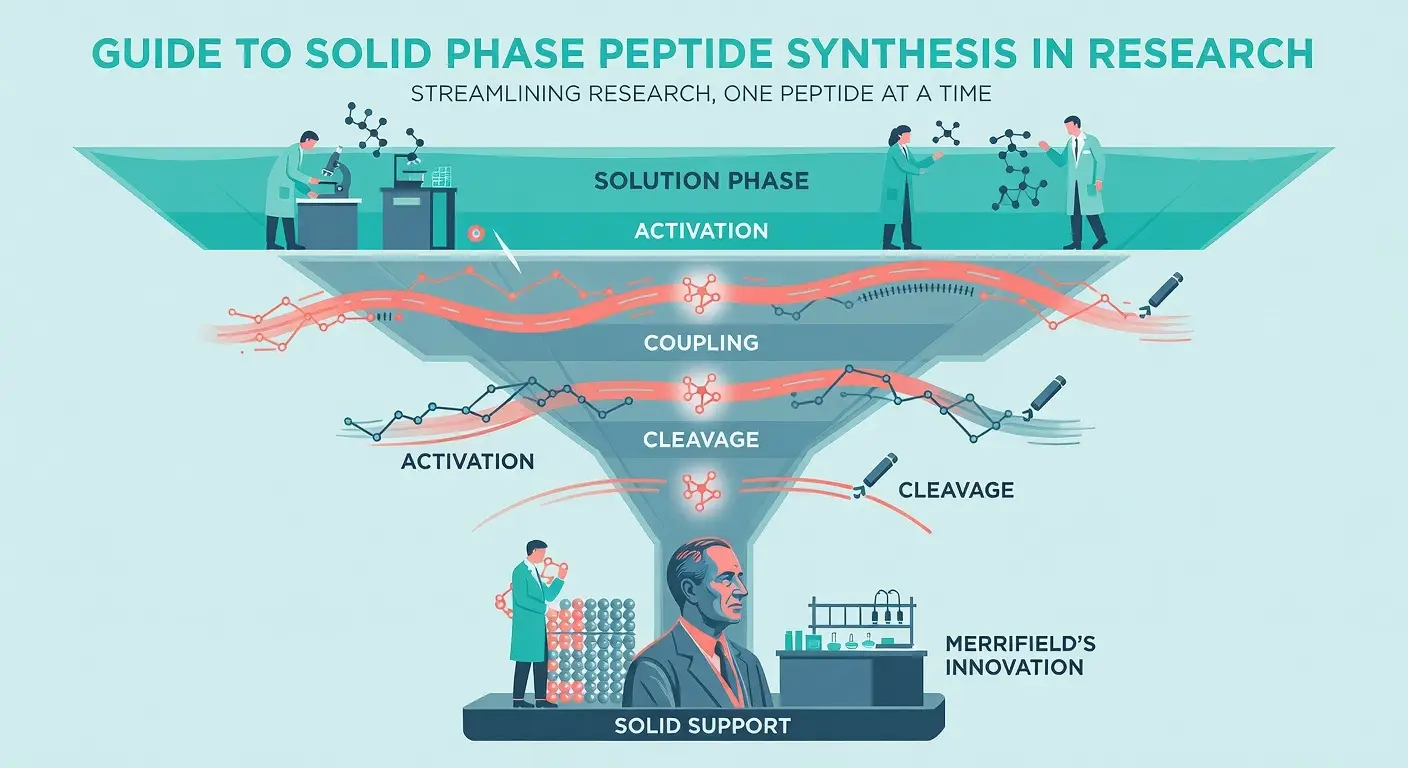
Solid phase peptide synthesis, pioneered by Robert Bruce Merrifield in 1963, anchors the growing peptide chain to an insoluble resin support. This innovation streamlines assembly by enabling sequential addition of amino acids, washing steps, and facile purification, all in a single reaction vessel. Its efficiency has made it indispensable in labs worldwide.
In this tutorial guide, you will gain a structured walkthrough of solid phase peptide synthesis protocols tailored for research settings. We cover resin selection, coupling strategies with activators like HBTU or DIC/HOBt, deprotection techniques, cleavage methods, and purification via HPLC. Expect practical tips on troubleshooting aggregation, racemization, and incomplete couplings, plus optimization strategies to boost yields above 80 percent. By the end, you will be equipped to synthesize custom peptides confidently and reproducibly for your experiments.
History and Development of SPPS
Solid-phase peptide synthesis (SPPS) was pioneered by Robert Bruce Merrifield in the early 1960s at Rockefeller University. Frustrated by the low yields and tedious purifications of solution-phase methods, Merrifield conceived the idea in 1959 and published the first successful tetrapeptide synthesis (Leu-Ala-Gly-Val) in 1963. He anchored the C-terminal amino acid to insoluble polystyrene resin beads, using Boc protection for the α-amino group and benzyl groups for side chains, with hydrofluoric acid for cleavage. This innovation allowed excess reagents to push couplings to completion while byproducts were washed away, drastically simplifying workflows. For this breakthrough in automated peptide assembly on solid supports, Merrifield earned the Nobel Prize in Chemistry in 1984.
Key Advancements Post-Merrifield
SPPS evolved rapidly, with the 1970s introducing Fmoc/tBu orthogonal protection (base-labile Fmoc for Nα, acid-labile tBu for sides) and resins like Wang for C-terminal esters. Automation followed in 1968, enabling scalable production. By the 1980s, Rink and Sieber linkers supported amide peptides, while RP-HPLC ensured >99% purity via analytical documentation like COAs and MS.
Dominance in Modern Research
By 2026, SPPS dominates research peptide production, holding 74-75% market share for custom, high-purity compounds strictly for laboratory use (RUO). It underpins a global market valued at USD 678-800 million, with 9-12% CAGR driven by demand for modified peptides in studies. Innovations like microwave-assisted automation yield consistent, lyophilized products stable for research storage. See detailed SPPS history and review. This foundation enables precise, verifiable peptide tools for ongoing lab investigations.
Core Principles and Key Components
Solid phase peptide synthesis (SPPS) builds peptides through a repetitive cycle starting from the C-terminus, where the first protected amino acid attaches covalently to an insoluble resin support. This approach, advancing Merrifield’s foundational work, enables precise chain elongation via sequential deprotection, coupling, and washing steps, with byproducts easily removed by filtration. Resins like polystyrene (PS) cross-linked with 1-2% divinylbenzene (e.g., Wang or Rink amide) provide mechanical stability and swell 4-6 times in solvents such as DCM or DMF, optimizing reagent access and reaction kinetics for sequences up to 50-100 residues. For challenging polar or aggregating peptides, PEG-based resins like Tentagel offer superior swelling (up to 10 mL/g) across a broader solvent range, reducing incomplete couplings and supporting yields over 95% when loading is maintained at 0.2-0.7 mmol/g. Researchers verify efficiency via Kaiser tests post-coupling, ensuring research-grade purity standards exceeding 99% by HPLC/MS, as provided in certificates of analysis (COAs) from suppliers like NorthWestPeptide.
Protected Amino Acids for Selective Assembly
Protected amino acids incorporate Nα-blocking groups like Fmoc (base-labile, removed with 20% piperidine in DMF) or Boc (acid-labile, TFA), paired with orthogonal side-chain protectors such as tBu (for Ser, Thr, Asp) or Bzl (for Cys, Tyr) in the dominant Fmoc/tBu strategy. This orthogonality prevents side reactions, facilitates on-resin modifications like cyclization, and accommodates labels or PEGylation for advanced research protocols. Fmoc dominates due to mild conditions, minimizing racemization below 1% even for hindered residues like Val or Ile.
Solvents and Activators for Efficient Coupling
DMF and NMP serve as primary solvents, promoting resin swelling and solvating protected amino acids during coupling. Activators such as HBTU (with HOBt) or DIC (with OxymaPure) form active esters for amide bond formation in 30-60 minutes, achieving coupling efficiencies above 99.5%. Emerging green alternatives like cyrene reduce toxicity while maintaining performance. For details on resins, see resins for SPPS. NorthWestPeptide’s RUO peptides, backed by rigorous analytics, empower such laboratory workflows. The SPPS services market, valued at USD 201 million in 2025, underscores growing demand for these high-purity tools.
The SPPS Cycle: Step-by-Step Process
Initial Attachment of Fmoc-Protected C-Terminal Amino Acid to Resin
The SPPS cycle commences with the covalent attachment of the first Fmoc-protected amino acid, representing the C-terminal residue, to a swellable polystyrene resin. Researchers typically select Wang resin for ester linkages, yielding peptides with free carboxylic acids upon cleavage, or Rink amide resin for stable amide linkages at the C-terminus. The resin, often 100-400 mesh with 1-2% divinylbenzene cross-linking, first swells in DMF or DCM for 30-60 minutes to enhance accessibility. Coupling employs pre-activated Fmoc-amino acid (3-5 equivalents) with activators like DIC/HOBt or DCC, in the presence of DIPEA base at room temperature for 1-4 hours. Completion is confirmed via weight gain or qualitative tests, followed by exhaustive washing with DMF, IPA, and DCM (5-7 cycles each) to eliminate byproducts. Pre-loaded resins streamline this step for routine laboratory research, ensuring the growing chain remains anchored yet reactive. For detailed protocols, see this overview of solid-phase peptide synthesis.
Nα-Deprotection and Washing
Selective removal of the Nα-Fmoc group exposes the free α-amine for subsequent coupling. In the preferred Fmoc/tBu strategy, 20-25% piperidine in DMF treats the resin for 3-30 minutes at room temperature, triggering β-elimination and forming a yellow dibenzofulvene adduct detectable at 301 nm UV. For legacy Boc/Bzl approaches, 50% TFA/DCM deprotects in 1-2 minutes, neutralized with DIPEA. Extensive washing immediately follows: DMF (3x), IPA (3x), and DCM (3x) to neutrality, preventing carryover of piperidine salts or TFA that could cause aspartimide formation or incomplete reactions. This step maintains >99% efficiency, critical for high-purity research peptides verified by HPLC/MS and COAs. Actionable tip: Monitor wash filtrate pH to confirm byproduct removal.
Coupling of the Next Protected Amino Acid
The deprotected resin then reacts with the next Fmoc-protected amino acid, pre-activated as an active ester or O-acylisourea. Standard reagents include HATU or HBTU (1-1.2 eq) with HOAt additive and DIPEA base in DMF/DCM, added in 3-5 fold excess for 1-2 hours agitation at room temperature. Difficult sequences benefit from double coupling or microwave assistance to exceed 99.5% conversion per cycle. Coupling completeness is assessed via the Kaiser test: Withdraw 10-15 beads, treat with ninhydrin/phenol/KCN reagents, and heat at 100°C for 5 minutes; colorless indicates success, blue signals free amines requiring recoupling. See Fmoc solid-phase peptide synthesis details for reagent optimization.
Repetition for Chain Elongation
These deprotection-coupling-wash-monitor cycles repeat iteratively, building the peptide from C- to N-terminus, typically accommodating sequences up to 50 residues with crude yields of 50-90%. Aggregation-prone motifs, like β-sheet formers, demand additives such as 20% DMSO or Hmb-Ala spacers. Post-synthesis, TFA-mediated global deprotection and resin cleavage, followed by HPLC purification, delivers research-use-only (RUO) peptides meeting ≥99% purity standards, documented analytically. For Boc vs. Fmoc comparisons, refer to Boc versus Fmoc strategies. This iterative process empowers precise laboratory investigations into peptide structure-function relationships.
Protecting Group Strategies in SPPS
Fmoc/tBu Strategy: The Gold Standard for Orthogonal Protection
In solid phase peptide synthesis (SPPS), the Fmoc/tBu strategy stands as the predominant orthogonal protecting group system, utilizing base-labile 9-fluorenylmethoxycarbonyl (Fmoc) for Nα-amino protection and acid-labile tert-butyl (tBu)-based groups for reactive side chains. Fmoc deprotection occurs efficiently with 20-30% piperidine in DMF over 3-20 minutes, monitored by the characteristic dibenzofulvene-piperidine adduct at 301 nm, ensuring complete removal without side chain interference. Side chain protections include tBu for Ser, Thr, Tyr, and Asp/Glu; Boc or Alloc for Lys; Trt for His and Cys; and Pbf for Arg, all cleaved simultaneously with 95% trifluoroacetic acid (TFA) containing scavengers like triisopropylsilane. This true orthogonality facilitates on-resin modifications, such as cyclization via selective Alloc deprotection or PEGylation for enhanced solubility in research peptides. For instance, researchers synthesizing cyclic peptides for binding studies benefit from these mild conditions, achieving crude purities exceeding 90% before HPLC purification to >99% as verified by analytical HPLC/MS. NorthWestPeptide’s research peptides employ this strategy to deliver consistent batches with full Certificates of Analysis (COAs), strictly for laboratory use only. See detailed Protecting Groups in Peptide Synthesis for side chain specifics.
Boc/Bzl Strategy: Niche Applications Despite Challenges
The Boc/Bzl approach, an earlier acid-labile system, protects the Nα-amino group with tert-butoxycarbonyl (Boc), removed by 50% TFA in DCM, while benzyl (Bzl)-based groups shield side chains like Ser/Thr/Tyr (Bzl), Asp/Glu (Bzl), Lys (Boc/Bzl), Cys (Bzl), and Arg (Tos), requiring harsh anhydrous HF cleavage at 0°C. This quasi-orthogonal method protonates the growing chain during deprotection, minimizing aggregation in hydrophobic sequences such as poly-Leu models, which improves coupling efficiency over 20-30% in difficult cases. However, HF’s toxicity, corrosiveness, and need for specialized equipment limit its adoption, often producing side products like tert-butyl cation adducts on Trp or Met unless scavenged properly. It remains useful for specific resins or base-sensitive constructs like depsipeptides, where Boc stability prevents hydrolysis. Researchers may select Boc/Bzl for legacy protocols or custom thioester resins, but purity post-cleavage typically demands extensive purification to meet >99% standards. For more on peptide synthesis FAQs, including Boc advantages in aggregating sequences.
Strategic Choice and Scalability in Modern SPPS
Protecting group selection profoundly influences SPPS scalability, with Fmoc/tBu dominating 2026 automated synthesizers due to 10-20 minute cycles, microwave acceleration (60-70% time reduction), and compatibility with continuous flow for peptides up to 100 residues at >99% purity. Boc/Bzl restricts automation owing to HF handling, confining it to <10% niche use. Market trends underscore this: the SPPS services sector, valued at USD 201 million in 2025, grows at 8.33% CAGR, driven by Fmoc-enabled high-throughput parallel synthesis of 96 peptides. Actionable insight: for research scalability, prioritize Fmoc/tBu resins like Rink amide with in situ neutralization to curb aspartimide formation, ensuring lyophilized products stable for 24 months under RUO storage. Explore SPPS vaccine market insights for purity benchmarks in automated systems. This choice empowers precise, high-purity research peptides essential for advancing laboratory investigations.
Cleavage, Purification, and Characterization
Global Deprotection and Resin Cleavage
Following the iterative coupling and deprotection cycles in solid phase peptide synthesis, the final assembly stage culminates in global deprotection and cleavage from the resin. This critical step employs trifluoroacetic acid (TFA) cocktails, typically 70-95% TFA with scavengers such as phenol, water, triisopropylsilane (TIPS), or ethanedithiol (EDT), to simultaneously remove Fmoc/tBu side-chain protectors and cleave the peptide from resins like Wang or Rink Amide. Common formulations include Reagent B (TFA/phenol/water/TIPS at 88:5:5:2), ideal for general use, or Reagent K (TFA/phenol/water/thioanisole/EDT at 82.5:5:5:5:2.5) for sequences containing methionine, cysteine, or tryptophan. Reactions proceed at room temperature for 1-4 hours under nitrogen, with 5-10 mL per gram of resin; pilot trials on 50-100 mg resin optimize conditions to minimize side reactions like aspartimide formation. Post-cleavage, the resin is filtered, and the crude peptide precipitates dropwise into cold diethyl ether (10 volumes, -20°C), followed by centrifugation (3300 rpm, 5 minutes), decanting, and three to four washes with fresh ether to remove TFA salts, scavengers, and low-molecular-weight impurities. This yields a crude product often exceeding 95% recovery, ready for purification, enhancing overall process efficiency in laboratory research settings. For detailed protocols, see solid-phase peptide synthesis overview.
Reverse-Phase HPLC Purification and Analytical Verification
Crude peptides, typically 50-90% pure, undergo reverse-phase high-performance liquid chromatography (RP-HPLC) on C18 columns using 0.1% TFA in water/acetonitrile gradients (e.g., 0-70% B over 30 minutes at 1 mL/min). Samples dissolve in minimal 0.1% TFA or 6 M guanidine, loading at 1-10 mg/mL; fractions collect based on UV detection at 220 nm, with analytical re-chromatography confirming purity. This achieves research-grade standards (>98-99% purity), verified by electrospray LC-MS for monoisotopic mass accuracy (<0.01%) and UV spectroscopy for identity. Mass spectrometry detects truncations or deletions overlooked by HPLC alone, ensuring compound integrity for analytical studies. NorthWestPeptide’s peptides exemplify these standards, supplied with documentation for research use only (RUO). See post-cleavage purification protocols for best practices.
Lyophilization and Certificate of Analysis (COA)
Purified fractions lyophilize into stable, white powders by shell-freezing in liquid nitrogen and vacuum sublimation, facilitating -20°C storage for up to 24 months with minimal degradation. COAs from ISO 17025-accredited labs document HPLC purity (>99%, water-corrected), precise mass (e.g., ±0.01 Da), and sequence confirmation via MS/MS fragmentation. Additional metrics include amino acid analysis, chirality checks, and residual solvents (<1% TFA). These rigorous analytics support reproducible laboratory research, underscoring the importance of purity in peptide investigations.
Advantages, Market Trends, and Innovations
Advantages of Solid Phase Peptide Synthesis
Solid phase peptide synthesis (SPPS) streamlines laboratory workflows by anchoring the growing peptide chain to an insoluble resin support throughout the assembly process. This retention on the resin allows researchers to wash away excess reagents, byproducts, and impurities after each deprotection and coupling cycle, drastically reducing purification complexity compared to solution-phase methods. For intermediate researchers, this means higher coupling efficiencies, often exceeding 99% per step, as excess protected amino acids can be used without complicating downstream isolation. The approach enables scalable synthesis from manual setups for short sequences to automated systems for peptides up to 50 residues, with final purity verified by HPLC and mass spectrometry. NorthWestPeptide exemplifies this by delivering research-use-only (RUO) peptides with comprehensive certificates of analysis (COAs), ensuring batch-to-batch consistency for reliable experimental outcomes. Practical insight: always monitor resin swelling in solvents like DMF to optimize washing efficiency and minimize aggregation risks.
Key Innovations Enhancing SPPS Efficiency
Recent advancements in SPPS focus on automation and sustainability, particularly for challenging long peptides. Microwave-assisted systems accelerate deprotection and coupling cycles to minutes, boosting overall yields by 30-40% through uniform heating and reduced side reactions. Continuous flow setups improve mass transfer and enable real-time monitoring, ideal for sequences over 30 residues in research labs. Green chemistry innovations, such as bio-based solvents and optimized resins like PEG variants, cut solvent consumption by up to 90%, aligning with eco-conscious protocols while maintaining high purity standards. These methods support modifications like cyclization or PEGylation, crucial for advanced research compounds. Researchers can leverage these for higher throughput; for instance, flow systems facilitate gram-scale production with minimal waste.
Market Trends Driving SPPS Adoption
The SPPS services market, valued at USD 201 million in 2025, is expanding at an 8.33% CAGR, reflecting surging demand for custom research peptides. In North America, the peptide synthesizers segment stands at USD 150 million, growing at 4.1% CAGR through 2033, fueled by automation investments. This growth underscores SPPS’s role in laboratory innovation, where providers like NorthWestPeptide offer pure, documented RUO peptides via batch search tools and expert support. Trends emphasize purity documentation and storage under lyophilized conditions for stability up to 24 months at -20°C. For researchers, outsourcing SPPS services ensures access to cutting-edge tools without in-house equipment burdens.
Quality Standards and Storage for Research Use
RUO Standards and Analytical Documentation
Research peptides produced via solid phase peptide synthesis (SPPS) must strictly adhere to Research Use Only (RUO) designations, ensuring they are suitable solely for laboratory, analytical, or in vitro applications. Full analytical documentation is essential for verifying quality and enabling reproducible experiments. This includes batch-specific Certificates of Analysis (COAs) detailing purity levels, typically targeting ≥99% for high-end research-grade products. Reverse-phase high-performance liquid chromatography (RP-HPLC) chromatograms provide purity assessment by measuring the main peak area against total UV-absorbing impurities at wavelengths like 214 nm or 280 nm; ideal profiles show sharp, single peaks with minimal truncation products. Electrospray ionization mass spectrometry (ESI-MS) spectra confirm molecular identity, matching observed monoisotopic masses to theoretical values within 0.1 Da tolerances. Actionable insight: always cross-reference vial lot numbers with provided raw data files to detect discrepancies early and maintain experimental integrity.
NorthWestPeptide’s Purity Assurance via SPPS
NorthWestPeptide upholds >99% purity standards through optimized Fmoc/tBu SPPS protocols, incorporating automated synthesis, multi-cycle RP-HPLC purification, and lyophilization. Each batch undergoes independent third-party testing, with COAs available upon request to support precise replication across studies. For instance, peptides like custom sequences or standards exhibit HPLC purities exceeding 99.5% and precise MS confirmation, minimizing side products that could skew binding assays or structural analyses. This commitment aligns with industry benchmarks, where high purity directly correlates with reliable data in protein interaction research.
Storage Protocols for Optimal Stability
Lyophilized peptides demand stringent storage to prevent degradation from moisture, oxidation, or thermal stress. Store at -20°C in sealed, desiccated vials with silica gel packs; under these conditions, stability extends up to 24 months. Avoid frost-free freezers due to humidity cycles, and minimize vial openings to prevent condensation. For short-term access, aliquots at room temperature are viable for weeks if protected from light. Reconstituted solutions should be kept at 2-8°C, with freezing aliquots at -80°C for extended use, using low-protein-binding tubes to reduce adsorption losses. Proper handling ensures consistent performance in downstream applications like enzyme kinetics studies.
Key Takeaways for SPPS in Laboratory Research
Mastering the Fmoc/tBu cycle remains essential for reliable solid phase peptide synthesis (SPPS) of custom research peptides in laboratory settings. This orthogonal strategy enables precise stepwise assembly on resin supports, achieving high yields for sequences up to 50 amino acids with minimal side reactions. Researchers can optimize coupling efficiency using activators like DIC/HOBt, ensuring >95% stepwise yields verified by Kaiser tests. For complex modifications such as cyclization or PEGylation, the base-labile Fmoc and acid-labile tBu groups provide flexibility without compromising purity.
Prioritize suppliers like NorthWestPeptide, which deliver HPLC/MS-verified peptides exceeding 99% purity, complete with Certificates of Analysis (COAs) for traceability. These RUO products support reproducible experiments, backed by lyophilized stability up to 24 months under -20°C storage.
Explore automation trends, including microwave-assisted synthesizers and continuous flow systems, alongside green innovations like solvent-reduced protocols and TentaGel resins, to boost lab scalability. The SPPS market’s 9-12% CAGR underscores these efficiencies. Request tailored quotes from NorthWestPeptide to ensure full compliance with research-only guidelines.
Conclusion
In summary, solid phase peptide synthesis revolutionizes biomedical research by enabling efficient, high-yield peptide production through resin-anchored assembly. Key takeaways include selecting optimal resins for your target peptide, mastering coupling strategies with activators like HBTU or DIC/HOBt, executing seamless deprotection and cleavage steps, and simplifying purification in one vessel. This guide delivers practical protocols that overcome the limitations of traditional methods, empowering intermediate researchers to innovate in drug discovery, vaccine development, and protein mimicry.
Armed with these insights, implement the outlined steps in your lab today and customize them for your projects. Embrace solid phase peptide synthesis to accelerate breakthroughs and transform your research trajectory. Your next discovery awaits.