Free ShippingOn Orders $150+Midweek Flash Sale30% Off Sitewide
30% OFF
COUPON CODE:
FLASH30
Ends Friday
New Customer Offer
Create an Account & Get 30% Off Your First Order
WELCOME30
Auto-Applied at Checkout
Free ShippingOn Orders $150+Midweek Flash Sale30% Off Sitewide
30% OFF
COUPON CODE:
FLASH30
Ends Friday
New Customer Offer
Create an Account & Get 30% Off Your First Order
WELCOME30
Auto-Applied at Checkout
Disclaimer: For research purposes only. Not for human or animal use and not FDA-approved.
By purchasing, you confirm that you are 21 years of age or older and are a qualified researcher.
$49.99
In stock
Purchase & earn 50 points!
Secure Payment Options
Zelle
V
venmo
mastercard
VISA
AMERICAN EXPRESS
Product Overview
Thymulin is a naturally occurring thymic peptide composed of nine amino acids and produced by thymic epithelial cells. It has been extensively investigated in laboratory research involving thymic signaling, immune-cell differentiation, neuroendocrine regulation, and peptide-mediated biological pathways. Thymulin is also known in scientific literature as serum thymic factor (FTS) and is notable for its interaction with zinc, which is associated with its biologically active form.
The terms Thymalin and Thymulin are sometimes used together or interchangeably in the research-peptide marketplace; however, they describe scientifically distinct materials. The compound supplied on this page is Thymulin, the defined nonapeptide, rather than the heterogeneous thymic extract traditionally known as Thymalin.
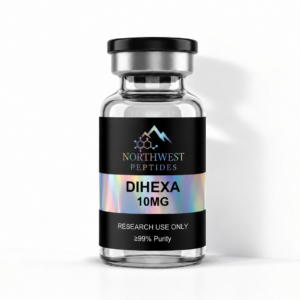
Northwest Peptides supplies Thymulin 10mg as a premium-quality lyophilized research peptide manufactured exclusively for laboratory research purposes. Every batch undergoes analytical verification and includes a batch-specific Certificate of Analysis.
Research Overview
Thymulin has been studied for decades as a thymus-derived signaling peptide involved in immune and neuroendocrine biology. Research has examined its relationship with thymocyte differentiation, immune-cell signaling, inflammatory pathways, and interactions between the thymus and endocrine system.
A distinguishing feature of Thymulin is its association with zinc. Scientific literature describes the biologically active thymulin complex as a nonapeptide associated with a zinc ion, making metal-dependent peptide activity an important area of experimental investigation.
Researchers have also examined Thymulin in experimental models involving neuroendocrine signaling, pituitary biology, inflammatory processes, and age-related changes in thymic function. Ongoing research remains focused on understanding its molecular mechanisms and biological signaling rather than establishing therapeutic outcomes.
Quick Facts
Specification
Details
Full Name
Thymulin
Alternative Research Name
Serum Thymic Factor / FTS
Common Marketplace Search Term
Thymalin
Peptide Class
Thymic Nonapeptide
Peptide Length
9 Amino Acids
Sequence
Pyr-Ala-Lys-Ser-Gln-Gly-Gly-Ser-Asn
Molecular Formula
C₃₃H₅₄N₁₂O₁₅
Molecular Weight
858.9 g/mol
CAS Number
78922-62-0
Purity
≥99% (HPLC Verified)
Form
Lyophilized Powder
Quantity
10mg
Storage
Store at -20°C in a dry environment away from direct light
Research Category
Immune / Thymic Research
PubChem lists Thymulin as a nine-residue peptide with molecular formula C₃₃H₅₄N₁₂O₁₅, molecular weight 858.9 g/mol, and CAS 78922-62-0.
Quality Assurance
Every batch of Thymulin undergoes strict quality verification before release.
≥99% Purity Verified by HPLC
Batch-Specific Certificate of Analysis (COA)
Identity Verification
Lyophilized for Long-Term Stability
Laboratory-Grade Packaging
Manufactured for Research Applications Only
Research Applications
Current published literature has investigated Thymulin in areas including:
Thymic signaling research
T-cell differentiation investigations
Immune-cell signaling pathways
Thymus–neuroendocrine interactions
Zinc-dependent peptide research
Inflammatory signaling studies
Pituitary and endocrine research
Age-related thymic biology
Experimental neurobiology
Literature Summary
Scientific interest in Thymulin dates back several decades. Research has characterized it as a thymus-derived nonapeptide produced by thymic epithelial cells and has examined its role in immune regulation and communication between the thymic and neuroendocrine systems.
Thymulin should not be chemically confused with Thymalin. Thymulin is a single defined peptide, whereas Thymalin traditionally refers to a heterogeneous polypeptide preparation derived from thymic tissue. Because the two names are sometimes grouped together commercially, Northwest Peptides identifies the actual research compound supplied here as Thymulin.
Related Research Peptides
Researchers investigating thymic signaling and immune-related peptide biology frequently explore Thymosin Alpha-1, Epitalon, Pinealon, Humanin, and other research peptides in complementary experimental settings. Selection of research materials should depend on the specific experimental design and research objective.
Frequently Asked Questions
What is Thymulin?
Thymulin is a naturally occurring thymic nonapeptide composed of nine amino acids. It has been widely investigated in laboratory research involving thymic signaling, immune-cell differentiation, and neuroendocrine biology.
Is Thymulin the same as Thymalin?
No. Although the names are sometimes used together in the research marketplace, they are scientifically distinct. Thymulin is a defined nine-amino-acid peptide, while Thymalin traditionally refers to a mixture of thymic peptides derived from thymus tissue. The compound supplied on this page is Thymulin.
Why does the product title include “Thymalin”?
“Thymalin” is frequently used as a search and marketplace term associated with thymic peptide products. It is included in the product title to help researchers locate the product, while the page clearly identifies the supplied compound as Thymulin.
Who may purchase Thymulin?
Northwest Peptides supplies Thymulin exclusively for lawful laboratory research purposes. Purchasers are responsible for ensuring compliance with all applicable laws and regulations.
How is Thymulin supplied?
Each vial contains 10mg of high-purity lyophilized Thymulin packaged in a sealed laboratory vial.
Does every batch include a COA?
Yes. Every production batch includes a Certificate of Analysis documenting applicable analytical testing and purity results.
How should Thymulin be stored?
For long-term stability, store lyophilized material at approximately -20°C in a dry environment away from direct light. Follow appropriate laboratory storage procedures after handling.
How quickly are orders shipped?
Orders are typically processed within one business day from our U.S. fulfillment facility. Products are packaged securely to help maintain integrity during transit.
References
Representative scientific sources include PubChem and peer-reviewed publications indexed in PubMed describing Thymulin structure, thymic biology, zinc-dependent activity, and thymus–neuroendocrine signaling.
Research Use Disclaimer
This product is intended strictly for lawful laboratory research purposes only. Not for human or veterinary consumption. Not intended to diagnose, treat, cure, or prevent any disease. This product has not been evaluated by the U.S. Food and Drug Administration.
Call to Action
Order Thymulin 10mg, commonly searched alongside the term Thymalin, from Northwest Peptides for high-purity, COA-verified laboratory research materials backed by rigorous quality standards.
No certificates match your search.
ⓘ
Note: Certificates of Analysis are displayed according
to the currently selected product variation. To view certificates for
other variations, switch the variation above, for example, change from
10mg to 30mg.
Used to determine whether a user is included in an A / B or Multivariate test.
18 months
_ga
ID used to identify users
2 years
_gali
Used by Google Analytics to determine which links on a page are being clicked
30 seconds
_ga_
ID used to identify users
2 years
_gid
ID used to identify users for 24 hours after last activity
24 hours
_gat
Used to monitor number of Google Analytics server requests when using Google Tag Manager
1 minute
_gac_
Contains information related to marketing campaigns of the user. These are shared with Google AdWords / Google Ads when the Google Ads and Google Analytics accounts are linked together.
90 days
__utma
ID used to identify users and sessions
2 years after last activity
__utmt
Used to monitor number of Google Analytics server requests
10 minutes
__utmb
Used to distinguish new sessions and visits. This cookie is set when the GA.js javascript library is loaded and there is no existing __utmb cookie. The cookie is updated every time data is sent to the Google Analytics server.
30 minutes after last activity
__utmc
Used only with old Urchin versions of Google Analytics and not with GA.js. Was used to distinguish between new sessions and visits at the end of a session.
End of session (browser)
__utmz
Contains information about the traffic source or campaign that directed user to the website. The cookie is set when the GA.js javascript is loaded and updated when data is sent to the Google Anaytics server
6 months after last activity
__utmv
Contains custom information set by the web developer via the _setCustomVar method in Google Analytics. This cookie is updated every time new data is sent to the Google Analytics server.
2 years after last activity
Jetpack's built-in visitor analytics. It records page views, referring sites, search terms, and outbound link clicks, and also carries the shared visitor-tracking library used by Jetpack Instant Search and WooCommerce Analytics.
Queues analytics events for Jetpack's Tracks library so none are lost if the page closes before they can be sent.
30 minutes
tk_tc
Used once per page load to work out which cookie domain the Tracks library should use, then removed as soon as it's read back.
Session (deleted immediately after use)
tk_aip
Stores a list of anonymous visitor IDs so they can be merged into one identity once a visitor is recognized.
Up to 5 years
tk_ai
Stores a randomly-generated anonymous visitor ID so Jetpack's Tracks analytics library can link tracking events to the same visitor.
Session in wp-admin; up to 5 years on the frontend
SourceBuster is used by WooCommerce for order attribution based on user source.
Name
Description
Duration
sbjs_udata
Information about the visitor’s user agent, such as IP, the browser, and the device type
session
sbjs_first
Traffic origin information for the visitor’s first visit to your store (only applicable if the visitor returns before the session expires)
session
sbjs_current
Traffic origin information for the visitor’s current visit to your store
session
sbjs_first_add
Timestamp, referring URL, and entry page for your visitor’s first visit to your store (only applicable if the visitor returns before the session expires)
session
sbjs_current_add
Timestamp, referring URL, and entry page for your visitor’s current visit to your store
session
sbjs_migrations
Technical data to help with migrations between different versions of the tracking feature
session
sbjs_session
The number of page views in this session and the current page path
30 minutes
Name
Description
Duration
affwp_ref_visit_id
Stores the visit ID linked to the referring affiliate.
1 day
affwp_campaign
Stores the affiliate campaign name for tracking purposes.
1 day
affwp_ref
Stores the referring affiliate ID for commission attribution.